
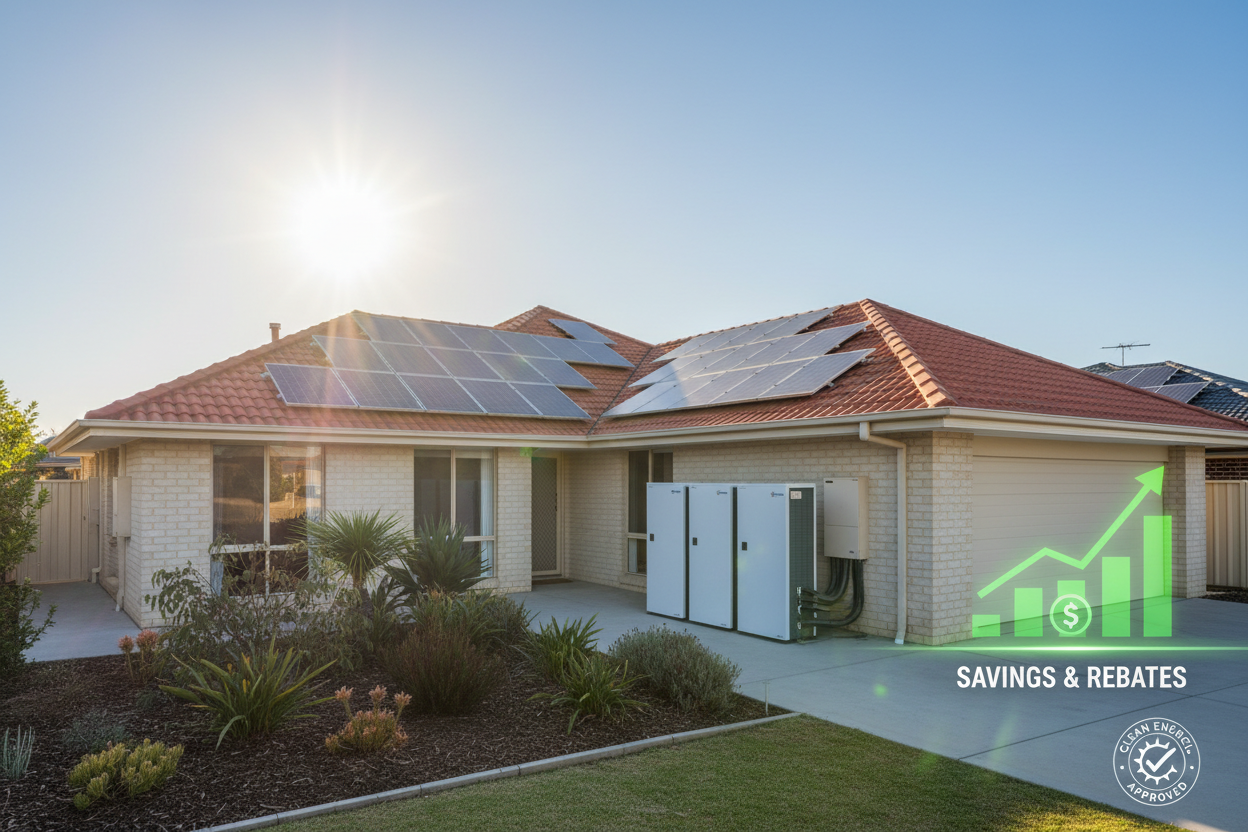
 As the solar market in Australia matures, the support mechanisms that fueled its early growth are changing. Starting 1 January 2026, the federal rebate under the Small-scale Renewable Energy Scheme (SRES) will be stepped down — a change that will reduce upfront subsidies for rooftop solar and home batteries.
For buyers who have been waiting on the fence, that shift raises a strategic question: is now the time to commit — or to wait?
Understanding the rebate mechanism & 2026 changes
-
Eligible solar and battery installations receive a certain number of STCs based on the remaining “deeming period” until the scheme ends (2030). From 2026 onwards, that deeming period shortens, which means fewer STCs per install.
-
For batteries specifically, the STC rate per kWh is being reduced — meaning the per‑kWh subsidy drops. For example, batteries installed in 2026 will generate fewer STCs than identical batteries installed in 2025.
-
Consequently, the total upfront discount on combined solar + storage setups will shrink — reducing the financial attractiveness of such systems when judged purely on rebate value.
Why battery storage could gain more importance in a post-rebate world
-
As subsidies fade, returning value depends increasingly on self-consumption rather than feed-in export. With feed-in tariffs dropping, the real economic advantage of a solar installation now often lies in storing solar-generated electricity for use during periods of high demand or expensive grid electricity.
-
Batteries — once seen largely as optional extras — become central to unlocking maximum value from solar. For energy-savvy buyers, this shift really marks the transition from “solar panel as discount asset” to “solar + battery as energy independence strategy.”
-
Moreover, with increasing awareness of grid stress, rising electricity prices, and growing demand for resilience (e.g., blackouts, EV charging), the long-term savings potential from battery storage may outstrip what rebates ever delivered.
Strategic advice for prospective buyers / homeowners / energy planners
-
If you’re considering a solar-plus-storage setup — now may be a good window to act, but only if you approach it strategically. Rushing in to “beat the 2026 rebate cut-off” without proper planning may result in suboptimal outcomes. Instead:
-
Evaluate your actual electricity load profile (usage times, peak demand, EV charging, growth plans).
-
Design a system that fits your long-term needs — not just your 2025 budget. E.g., plan for future battery expansion, consider hybrid inverters, and choose high-quality components with long-term warranty and performance support.
-
Consider total lifecycle cost and payback period rather than upfront discount. As rebates shrink, payback increasingly depends on energy savings, self-consumption, and reliability.
-
-
For energy businesses, installers, or retailers: this is a call to shift the sales narrative. Focus less on short-lived rebates, more on system value, resilience, and long-term savings. Educate customers about total cost of ownership, performance, and potential grid‑independence benefits.
Conclusion — a market maturing beyond subsidies
The 2026 rebate reduction under SRES isn’t a death knell for solar — it’s a signal that the Australian solar market is entering a new, more mature phase. A phase where quality, smart design, and energy strategy — not just government discounts — will define real value. For homeowners committed to energy independence and long-term savings, that could be the opportune moment to invest in a solar-plus-storage system designed for the next decade.
Learn more or explore deals: BESS Australia Supply & Installation Deals
