
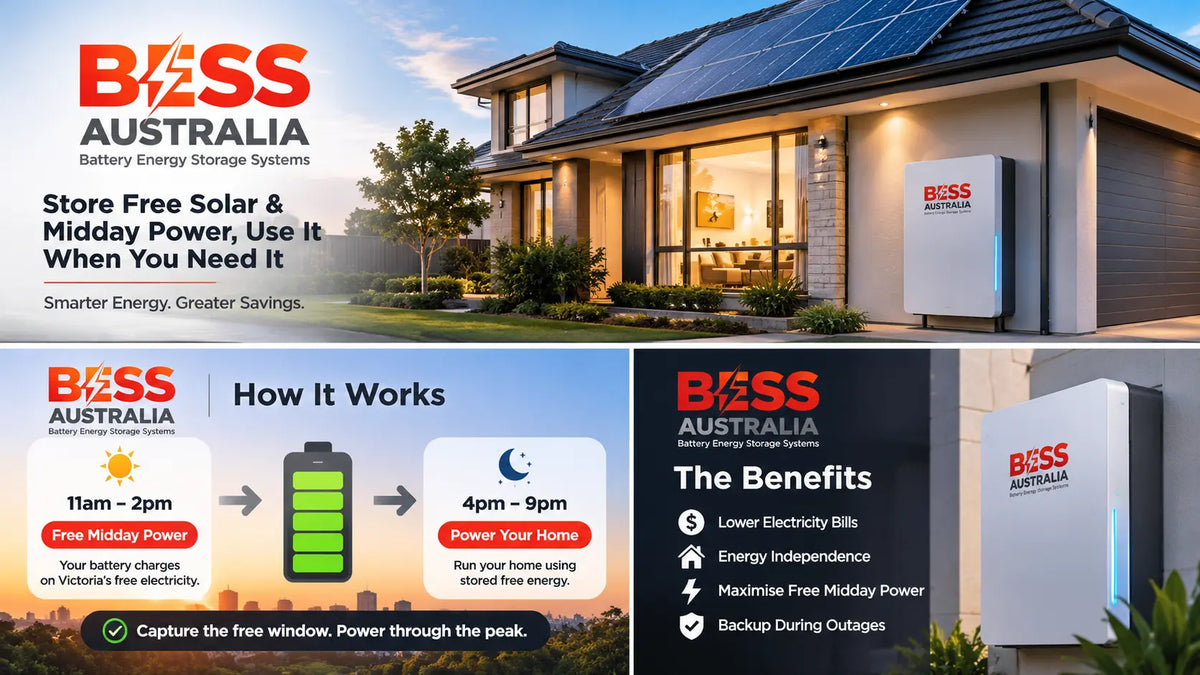
Not Home at Lunchtime? Here's How to Capture Victoria's Free Midday Power
Short answer: Victoria's Midday Power Saver gives you up to 24 kWh of free electricity a day between 11am and 2pm — but the free power is only useful if you can use it in that window, and most households are at work or school. A home battery solves this: it charges on free midday power and discharges through the expensive evening peak, so you effectively run your evening on electricity that cost you nothing. For most working families, that's what turns the free window from a nice idea into a real cut to the bill.
Here's how it works, and how to pick a battery that actually fits your home.

The problem with "free" midday power
Three free hours sounds great until you look at the clock. From 11am to 2pm on a weekday, a typical home is close to empty — nobody's running the oven, the dryer or the heating. The appliances that do use power in that window (fridge, standby devices) add up to a small fraction of the free 24 kWh on offer.
Meanwhile, the household's real demand lands in the evening peak — roughly 4pm to 9pm: cooking, heating or cooling, hot water, screens, EV charging. That's exactly when grid power is most expensive.
So the free power arrives when you don't need it, and the dear power arrives when you do. A battery closes that gap.
How a battery captures the free window
The logic is simple:
-
11am–2pm: your battery charges up on free grid power (up to its capacity).
-
4pm–9pm: your battery runs the house, so you draw little or nothing from the grid during the most expensive hours.
You're not using less energy — you're buying it at $0 and spending it when it would otherwise cost the most. Add solar and it's even better: solar fills the battery first, and the free midday window tops up whatever solar didn't cover (cloudy days, bigger homes, winter).
It's the same reason batteries pair so well with the scheme that the two are really one decision now: the Midday Power Saver makes the input free; the battery decides when you get to use it.

How big a battery do you need?
This is the question that matters, and the honest answer is: it depends on your evening usage, not a rule of thumb. A good size is one that can cover your 4pm–9pm consumption from a single midday charge.
As a rough orientation (not a recommendation — your actual bill is what counts):
-
A smaller home with modest evening use might cover its peak with a compact battery.
-
A family home with cooking, heating/cooling and a couple of EVs charging at night needs considerably more usable capacity, and may benefit from a modular/stackable system it can expand later.
The reliable way to size it is to look at your interval data — when you actually use power across the day — and match the battery to your evening load and the 24 kWh free cap. That's a 15-minute conversation, and it's the difference between a battery that pays off and one that's too small to bank the free power or too big to fill. Request a quote and we'll size it against your real usage.
What to look for in a battery for this scheme
Rather than chase a single "best" battery, match these four things to your home:
-
Usable capacity (kWh) — enough to carry your evening peak. This is the number that drives your savings under the scheme.
-
Charge rate (kW) — the battery needs to fill meaningfully inside the 3-hour free window. A higher continuous charge rate banks more free energy per day.
-
Expandability — modular systems (stackable kWh) let you start sensibly and add capacity if an EV or more load arrives later.
-
Backup — if blackout protection matters to you, check the system supports it (not all do, and some need extra hardware).
We stock tier-1 options that suit this pattern well — from integrated all-in-one units with strong charge rates, to modular systems you can grow, to V2H-capable platforms if an EV is part of your plan. The right pick depends on your evening load, your roof, and your budget. Our guide to the best solar battery brands in Australia walks through the real trade-offs between the leading systems.
Does the maths actually work?
Two things have shifted the maths in favour of a battery in Victoria right now:
-
Free input energy. The Midday Power Saver removes the charging cost that used to eat into battery savings — you're filling it for free instead of paying off-peak rates.
-
A cheaper battery. The federal Cheaper Home Batteries Program takes around 30% off an installed system. That discount steps down from 1 January 2027, so a system installed now captures more of it than one installed next year.
Together, free charging plus a lower upfront cost shortens the payback for a well-sized system compared with a year ago. It won't be identical for every home — payback depends on your usage, your plan's evening rates, and the system you choose — which is exactly why we model it on your numbers rather than quote a headline figure.

The bottom line
Victoria's free midday power is one of the best energy deals in the country — but for most households it's a battery that unlocks it. Bank the free 11am–2pm energy, spend it through the 4pm–9pm peak, and the scheme stops being a lunchtime curiosity and starts cutting your actual bill.
The next step is a battery sized to your evening, not a generic one. Book a free assessment and we'll model it against your usage and the current rebate — and if a battery isn't right for your situation, we'll tell you that too.
FAQ (for on-page FAQ block + FAQPage schema)
Can I use the free midday power if I'm not home during the day? Yes — with a home battery. The battery charges on the free 11am–2pm power while you're out, then runs your home through the evening. Without a battery (or the ability to shift appliances into the window), an empty house uses only a small fraction of the free 24 kWh on offer.
Is a battery worth it with the Midday Power Saver? For most households with high evening usage, the scheme improves the case for a battery, because you charge it for free instead of paying for the energy. Combined with the current federal rebate, that shortens payback versus a year ago. It depends on your usage and plan, so it's worth modelling on your actual bill.
How do I store free midday electricity? A home battery does it automatically. You set it to charge during the free 11am–2pm window and discharge during the evening peak. If you have solar, it fills from solar first and tops up from the free grid window. No manual effort is needed once it's configured.
How big a battery do I need to capture the free window? Enough usable capacity to cover your evening (roughly 4pm–9pm) usage from one midday charge, and a charge rate high enough to fill inside the 3-hour window. The right size comes from your interval usage data, not a rule of thumb — a quick assessment of your bill gives the accurate answer.
Do I need solar as well, or just a battery? You don't need solar to benefit — a battery can charge entirely from the free midday grid window. Solar makes it better by filling the battery for free on sunny days, with the midday window topping up the rest. Many Victorian homes add a battery to existing solar for exactly this reason.