
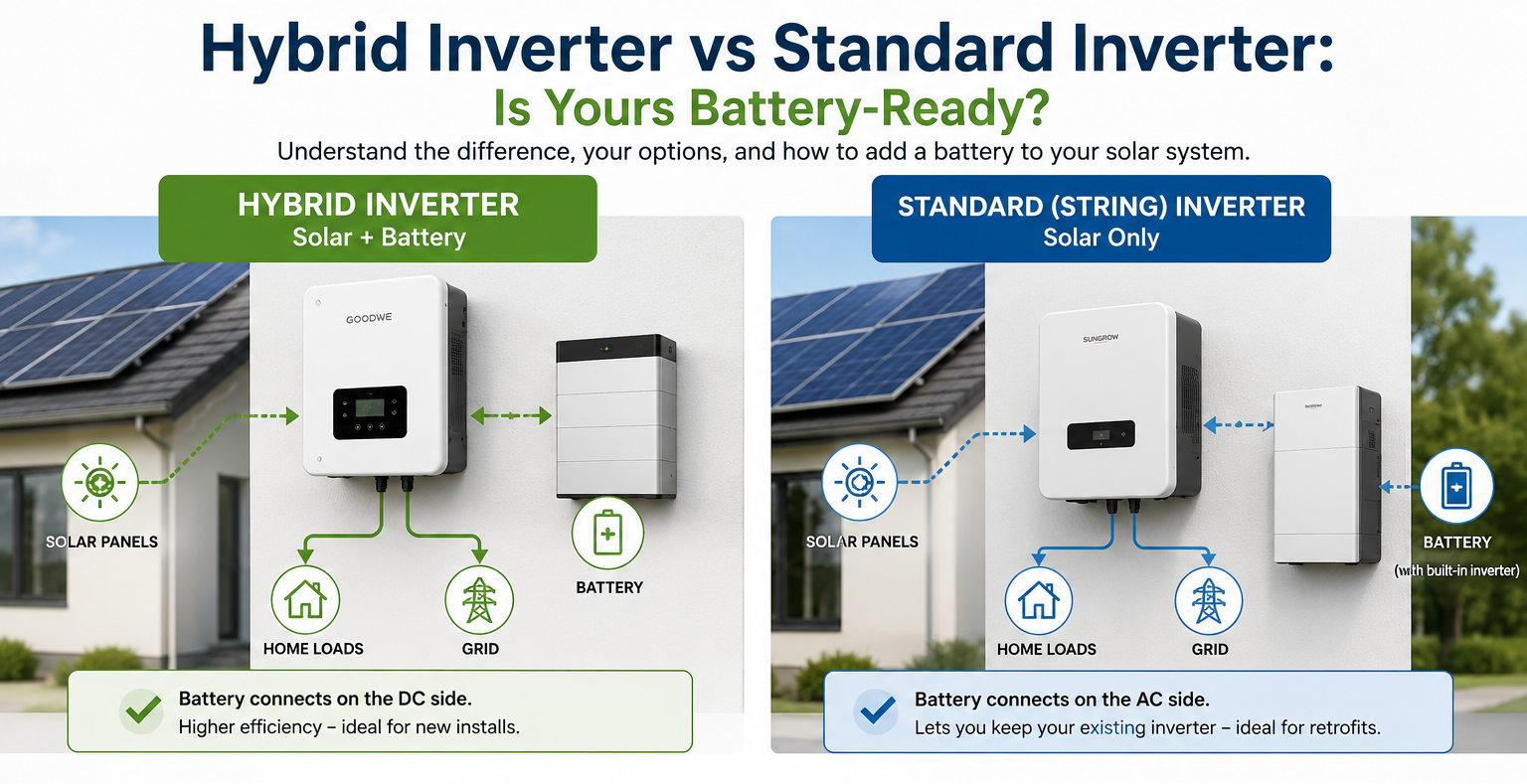
Hybrid Inverter vs Standard Inverter: Is Yours Battery-Ready?
Quick answer: A hybrid inverter manages both solar panels and a battery in one unit, while a standard (string) solar inverter handles solar only. You don't always need a hybrid inverter to add a battery — if you have a standard inverter, you can often keep it and add an AC-coupled battery instead of replacing it. Whether a hybrid inverter vs a standard solar inverter is right for you depends on whether you already have solar and whether storage is in your plans.
The inverter is the part of your system that quietly decides whether adding a battery later is simple or expensive. Get it right and a future battery plugs straight in; get it wrong and you may face an inverter replacement you didn't budget for. This guide explains the difference, whether you need a hybrid, and how to add a battery to an existing system.
BESS Australia is an accredited, multi-brand supplier and installer of solar inverters and home battery systems, supplying equipment Australia-wide and installing across Brisbane, the Sunshine Coast, the Gold Coast, Sydney and Melbourne.
What is the difference between a hybrid and standard inverter?
A standard (string) solar inverter converts solar energy into usable power for your home and the grid, while a hybrid inverter does that and also charges and discharges a battery. The hybrid is essentially a standard inverter with built-in battery management.
An inverter converts the DC electricity your solar panels generate into the AC electricity your home uses. A standard or "string" inverter is built for solar only — it has no way to manage storage. A hybrid inverter adds battery control, so it can send surplus solar to a battery and draw it back later. That single difference is why your inverter type determines how easy it is to add storage.
Do I need a hybrid inverter for a battery?
You don't necessarily need a hybrid inverter for a battery — you need either a hybrid inverter or an AC-coupled battery solution that brings its own inverter. There are two valid ways to power a battery, and only one of them involves a hybrid inverter.
The distinction comes down to coupling. DC-coupling connects the battery to a hybrid inverter on the DC side — efficient and common for new installs. AC-coupling uses a battery with its own built-in inverter (an all-in-one unit) or a separate battery inverter, connecting on the AC side — which lets you keep an existing standard inverter. So if someone tells you a battery always requires replacing your inverter, that's not the full picture.
Not sure if your inverter is battery-ready? Find out whether you can add a battery without replacing your inverter — call 1300 859 066, email sales@bessaustralia.com.au, or request a tailored quote.
Can I add a battery to my existing solar inverter?
In many cases, yes — you can add a battery to existing solar either by keeping your standard inverter and adding an AC-coupled battery, or by replacing it with a hybrid inverter and adding a DC-coupled battery. Which path suits you depends on your current inverter and your goals.
If your existing inverter is already a battery-ready hybrid — meaning it was installed with future storage in mind — you can usually add a compatible DC-coupled battery without replacing anything. If you have a standard string inverter, you can keep it and add an AC-coupled battery (such as an all-in-one unit), or replace it with a hybrid inverter. A site assessment confirms which option fits your system, because compatibility shouldn't be assumed.

AC-coupled vs DC-coupled: the two ways to add a battery
DC-coupled batteries connect to a hybrid inverter and are slightly more efficient, while AC-coupled batteries bring their own inverter and let you keep your existing solar inverter. Both work well — the right one depends on whether you're retrofitting or starting fresh.
|
DC-coupled (hybrid inverter) |
AC-coupled (all-in-one / battery inverter) |
|
|
How it connects |
Battery connects to a hybrid inverter on the DC side |
Battery brings its own inverter, connects on the AC side |
|
Best for |
New solar-and-battery installs |
Retrofitting a battery to existing solar |
|
Your existing inverter |
Replaced by (or is) the hybrid inverter |
Kept in place |
|
Efficiency |
Slightly higher (one conversion step) |
Slightly lower (an extra conversion step) |
|
Typical examples |
GoodWe Lynx, BYD or Sungrow with a hybrid inverter |
Tesla Powerwall 3, GoodWe ESA |
The efficiency gap between the two is small, so for a retrofit the convenience of keeping your existing inverter often outweighs it. For a new install, a DC-coupled hybrid setup is usually the cleaner choice.
When should you replace your inverter?
Replace your inverter with a hybrid when your existing string inverter is ageing, failing, or being installed fresh alongside solar — but if your current inverter is newer and working well, an AC-coupled battery usually makes more sense. Don't replace a healthy inverter unnecessarily.
If your inverter is near the end of its life (many last around 10–15 years), pairing the replacement with a hybrid model is a sensible time to make your system battery-ready. Replacing an inverter does add to the cost — often somewhere in the range of $1,500–$3,000 depending on the unit and install, as an indicative figure — so if your inverter has years left, AC-coupling a battery avoids that spend and avoids disturbing your existing solar and battery setup. Your installer can advise which is more cost-effective for your situation.
Battery-ready inverters: planning ahead
A battery-ready inverter is a hybrid inverter installed now so you can add a battery later without replacing it — a smart move if storage is on your roadmap but not your budget yet. It future-proofs your system from day one.
If you're installing or upgrading solar and expect to add a battery within a few years, choosing a hybrid inverter upfront avoids paying twice. The hybrid simply runs as a solar inverter until you connect storage, then takes over battery management. Many of the hybrid inverters in our GoodWe hybrid inverter and battery range are designed to be installed battery-ready in exactly this way.
Single-phase vs three-phase hybrid inverters
Hybrid inverters come in single-phase and three-phase versions, and the right one must match your home's electrical supply. Most Australian homes are single-phase; larger or higher-load homes are often three-phase.
A single-phase home needs a single-phase hybrid inverter, while a three-phase home can use a three-phase hybrid inverter to manage power across all three phases. Getting this match right matters for both performance and backup, which is one more reason the inverter decision should follow a check of your supply rather than precede it. Brands like Fox ESS offer both — you can see options in our Fox ESS hybrid inverter range.
Choosing the best inverter for solar and battery
The best inverter for your solar and battery system is one that's CEC-approved, matches your home's phase, suits your chosen battery, and is sized for your solar and loads. "Best" here means best fit for your home, not a single universal winner.
Key things to check: that the inverter is on the Clean Energy Council approved list (you can verify via the Clean Energy Council), that it's compatible with the battery you want (for DC-coupled setups), that it matches your single- or three-phase supply, and that its capacity suits your solar array and household loads. Because these factors interact, the inverter and battery are best chosen together rather than separately.
Cost and efficiency considerations
A hybrid inverter costs a little more than a standard inverter but saves you a future replacement if you add a battery, while AC-coupling avoids inverter replacement entirely for retrofits. The economics depend on your timing.
DC-coupled hybrid systems are marginally more efficient because energy passes through fewer conversions, but the real-world difference is small for most homes. The bigger cost factor is whether you replace an inverter or keep it — so the cheapest path often comes down to the age and health of your current inverter. Any savings or efficiency figures are estimates that depend on your system and usage.
How BESS Australia helps you get the inverter right
BESS Australia is an accredited supplier and installer of solar inverters and battery systems, carrying an extensive range of tier-1 brands — including GoodWe, Fox ESS, Sigenergy, Tesla, BYD and Sungrow — under one roof. Because we work across both hybrid and AC-coupled solutions, we can recommend the path that suits your existing system rather than defaulting to an inverter replacement you may not need.
Our trust signals are straightforward: CEC-approved products, Smart Energy Council membership, the NETCC Approved Seller consumer-protection code, installation by Solar Accreditation Australia-accredited installers, manufacturer warranties, a workmanship warranty, and Australian Consumer Law protections. We also offer a Lowest Price Guarantee, finance options and rebate assistance — the federal Cheaper Home Batteries Program provides a discount toward eligible battery installations, with the discount reducing over time through to 2030 and eligibility depending on the product, install and current rules.
Check your inverter before you buy a battery. Ask BESS Australia whether your system is battery-ready and which path is most cost-effective — call 1300 859 066, email sales@bessaustralia.com.au, or use our request a tailored quote form. We'll assess your inverter, phase and goals, then recommend the right setup.
3. FAQ
What is the difference between a hybrid and standard inverter? A standard (string) inverter converts solar energy into usable power for your home and the grid, handling solar only. A hybrid inverter does that and also charges and discharges a battery, managing both solar and storage in one unit. The hybrid is what makes a system battery-ready, which is why your inverter type affects how easily you can add storage later.
Do I need a hybrid inverter for a battery? Not necessarily. You need either a hybrid inverter (for a DC-coupled battery) or an AC-coupled battery that brings its own inverter. AC-coupling lets you keep an existing standard inverter and add an all-in-one battery alongside it. So a battery doesn't always require replacing your inverter — it depends on your setup and the battery you choose.
Can I add a battery to my existing solar inverter? In many cases, yes. If you already have a battery-ready hybrid inverter, you can add a compatible DC-coupled battery. If you have a standard string inverter, you can keep it and add an AC-coupled battery, or replace it with a hybrid inverter. A site assessment confirms which path suits your system and is most cost-effective.
When should I replace my inverter to add a battery? Replace it with a hybrid inverter if your current inverter is ageing or failing, or if you're installing solar fresh. If your existing inverter is newer and working well, an AC-coupled battery usually makes more sense, because it avoids replacing a healthy inverter and the extra cost that involves. Your installer can advise the cheaper path.