
How to Charge Your EV From Solar at Home in 2026
Quick answer: You can charge your EV from solar at home with a home EV charger — ideally a smart charger that prioritises your surplus daytime solar, so you fill the car with your own energy instead of buying it. You don't need a battery to charge an EV from solar, but one helps if you charge at night or want to store solar for evening charging. The right size solar depends on your driving, and a home EV charger with solar works best when it's matched to your home's electrical phase and load.
Charging your EV on your own solar is the cheapest way to run an electric car — but the setup matters. This guide covers how solar EV charging works, whether you need a battery, what size solar to aim for, and how to choose the right charger.
BESS Australia is an accredited, multi-brand supplier and installer of solar panels, batteries and home EV chargers, supplying Australia-wide and installing across Brisbane, the Sunshine Coast, the Gold Coast, Sydney and Melbourne.
Can I charge my EV from solar?
Yes — you can charge your EV from solar using a home EV charger, and a smart charger can be set to draw only from your surplus solar so you charge on your own free energy. This is the most cost-effective way to charge.
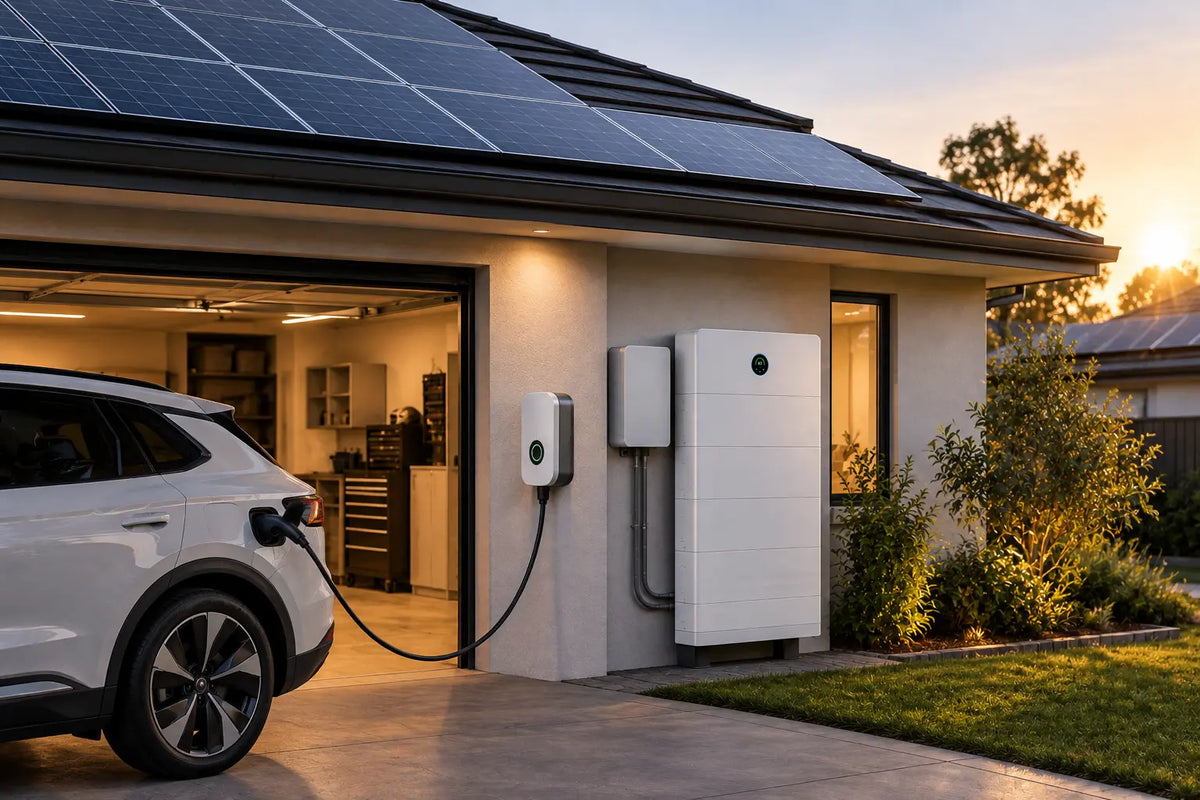
A home EV charger (typically a "Level 2" wall-mounted unit) charges far faster than a standard power point and can be paired with solar diversion — a smart feature that charges the car from your excess solar rather than the grid. When your panels are generating more than the house is using, that surplus goes into the car instead of being exported for a low feed-in rate. The result is charging that costs very little, because you're using energy you've already generated.
Do I need a battery to charge an EV with solar?
No — you don't need a battery to charge an EV from solar. You can charge directly from your panels during the day, and charging straight from daytime solar is actually the most efficient way to do it. A battery is optional, and helps in specific situations.
Charging directly from solar avoids the small energy losses of storing power in a battery first, so if you can charge during daylight — working from home, or on weekends — you may not need storage at all. A home battery becomes useful if you mostly charge at night, or want to store daytime solar to charge the car in the evening. For many EV owners, the ideal is daytime solar charging, with a battery covering the rest of the home's evening use.
Want to run your car on sunshine? Set up solar-powered EV charging for your home — call 1300 859 066, email sales@bessaustralia.com.au, or request a tailored quote.
What size solar do I need for an EV?
The size of solar you need for an EV depends on how far you drive, but as a rough guide an average Australian driver adds around 7–10 kWh of daily usage, so many EV owners add roughly 3–5 kW of extra solar or opt for a larger 10–13 kW system. Match the array to your driving and charging pattern.
An EV uses roughly 15–20 kWh per 100 km, so a typical 40–50 km of daily driving adds about 7–10 kWh a day — though a full charge of a larger battery can be 40–75 kWh depending on the model. If you want to cover most of that from solar, a bigger array helps, especially in winter when generation is lower. A well-sized set of solar panels sized with your EV in mind means you're charging on your own energy rather than importing it.
Choosing a home EV charger
Choose a home EV charger based on your home's electrical phase, the charging speed you need, and smart features like solar diversion and load management — the right charger is the one matched to your home and driving, not simply the fastest. Most homes use a Level 2 charger.
|
Charger type |
Typical power |
Speed |
Best suited to |
|
Level 1 (standard power point) |
~2 kW |
Slow (trickle) |
Occasional top-ups, low daily mileage |
|
Level 2, single-phase |
~7 kW |
A typical daily charge overnight or in a few hours |
Most homes |
|
Level 2, three-phase |
~11–22 kW |
Fastest home charging |
High-mileage drivers, three-phase homes |
Charging speeds also depend on your EV's onboard charger, so a faster wall unit only helps if your car can accept the higher rate. Smart features matter more than raw speed for most people: solar diversion, scheduling and app control let you charge cheaply and automatically.
Single-phase vs three-phase EV charging
A single-phase home EV charger typically delivers up to around 7 kW, while a three-phase charger can deliver roughly 11–22 kW for faster charging — so the right choice depends on your home's supply and how quickly you need to charge. Most Australian homes are single-phase.
For everyday driving, a 7 kW single-phase charger is usually plenty — it can add a typical day's range in a few hours or a full charge overnight. Three-phase charging suits high-mileage drivers or households that need to top up quickly, and requires a three-phase supply. Your home's phase is one of the first things to confirm when planning a charger, which a site assessment covers.
Load management: don't overload your supply
Because an EV charger is a large, sustained load, load management balances it against the rest of your home's usage so you don't overload your electrical supply — which matters most on single-phase homes. It's a key part of a safe install.
Load management (or dynamic load balancing) is a feature that automatically reduces the charger's draw when other big appliances — air-conditioning, an oven, a heat pump — are running, then ramps it back up when there's capacity. On a single-phase home running several large loads, this prevents nuisance trips and keeps everything within your supply's limits. It's the kind of detail an accredited installer builds in, rather than something to discover later.
The smart way: charge from daytime solar
The smartest, cheapest way to charge an EV is from your surplus daytime solar, using a smart charger set to prioritise excess generation. It turns your car into a flexible daytime load.
Self-consumption — using your own solar rather than exporting it — is the goal, and an EV is one of the best loads to soak up surplus solar because charging can happen whenever there's sun. Scheduling charging for the middle of the day captures generation that would otherwise be exported cheaply. In states with a free midday window — the Solar Sharer Offer or Victoria's Midday Power Saver — you can even schedule charging into those free hours.
Do EV chargers qualify for any support?
Home EV chargers are an eligible upgrade under the NSW Home Energy Saver loan, and some states offer EV-related incentives that change over time — while a battery added alongside is eligible for the federal battery rebate. Support depends on where you live and current rules.
In NSW, the Home Energy Saver loan offers eligible households an interest-free loan of up to $15,000 toward energy upgrades including EV chargers, delivered by approved providers Brighte and Plenti and subject to credit approval. Some states also run their own EV or charger incentives, which change regularly, so check what currently applies. If you add a battery, the federal Cheaper Home Batteries Program provides a discount that reduces over time through to 2030 (eligibility depends on the product, install and current rules). For general guidance on EVs and home energy, the Australian Government's Your Home site is a useful reference.
EV, solar and battery: the full setup
Combining an EV charger, solar and a battery gives you the most self-sufficient setup — you charge from daytime solar, store the surplus, and run both the car and home on your own energy. Each part adds flexibility.
For households wanting maximum independence, the battery covers evening home use (and can charge the car in the evening if needed), while daytime solar does the heavy lifting for the car. It's worth remembering that direct daytime solar charging is the most efficient path, so a battery is about flexibility and evening use rather than a requirement for solar charging.
How BESS Australia helps
BESS Australia is an accredited supplier and installer of EV chargers, solar and battery systems, offering complete supply-and-install packages as well as equipment-only supply Australia-wide. Because we cover charging, solar and storage under one roof, we can design a setup where your charger, array and any battery work together — and assess your phase and load so the install is safe and future-ready.
Our trust signals are straightforward: CEC-approved products, Smart Energy Council membership, the NETCC Approved Seller consumer-protection code, installation by Solar Accreditation Australia-accredited installers, manufacturer warranties, a workmanship warranty, and Australian Consumer Law protections. We also offer a Lowest Price Guarantee, finance options and rebate assistance. Any savings we discuss are estimates that depend on your household, driving and tariff — never guarantees.
Charge your EV on your own solar. Ask BESS Australia to design a solar-powered EV charging setup for your home — call 1300 859 066, email sales@bessaustralia.com.au, or use our request a tailored quote form.
FAQ
Can I charge my EV from solar? Yes. With a home EV charger — ideally a smart charger with solar diversion — you can charge the car from your surplus daytime solar rather than the grid. When your panels generate more than the house is using, that excess goes into the car instead of being exported cheaply. It's the most cost-effective way to charge an EV.
Do I need a battery to charge an EV with solar? No. You can charge directly from your panels during the day, and charging straight from daytime solar is the most efficient approach. A battery helps if you mostly charge at night or want to store daytime solar for evening charging, but it isn't required for solar EV charging. Many owners charge by day and use a battery for the home's evening use.
What size solar do I need for an EV? It depends on your driving. An average Australian driver adds roughly 7–10 kWh of daily usage, so many EV owners add around 3–5 kW of extra solar or choose a larger 10–13 kW system to cover it, with more helpful in winter. A quick look at your driving and charging pattern gives a realistic size for your home.
Is a single-phase EV charger fast enough? For most drivers, yes. A single-phase Level 2 charger typically delivers up to around 7 kW, which can add a day's range in a few hours or a full charge overnight. Three-phase charging (roughly 11–22 kW) suits high-mileage drivers or those needing quick top-ups, and requires a three-phase supply. Your car's onboard charger also affects the speed.