
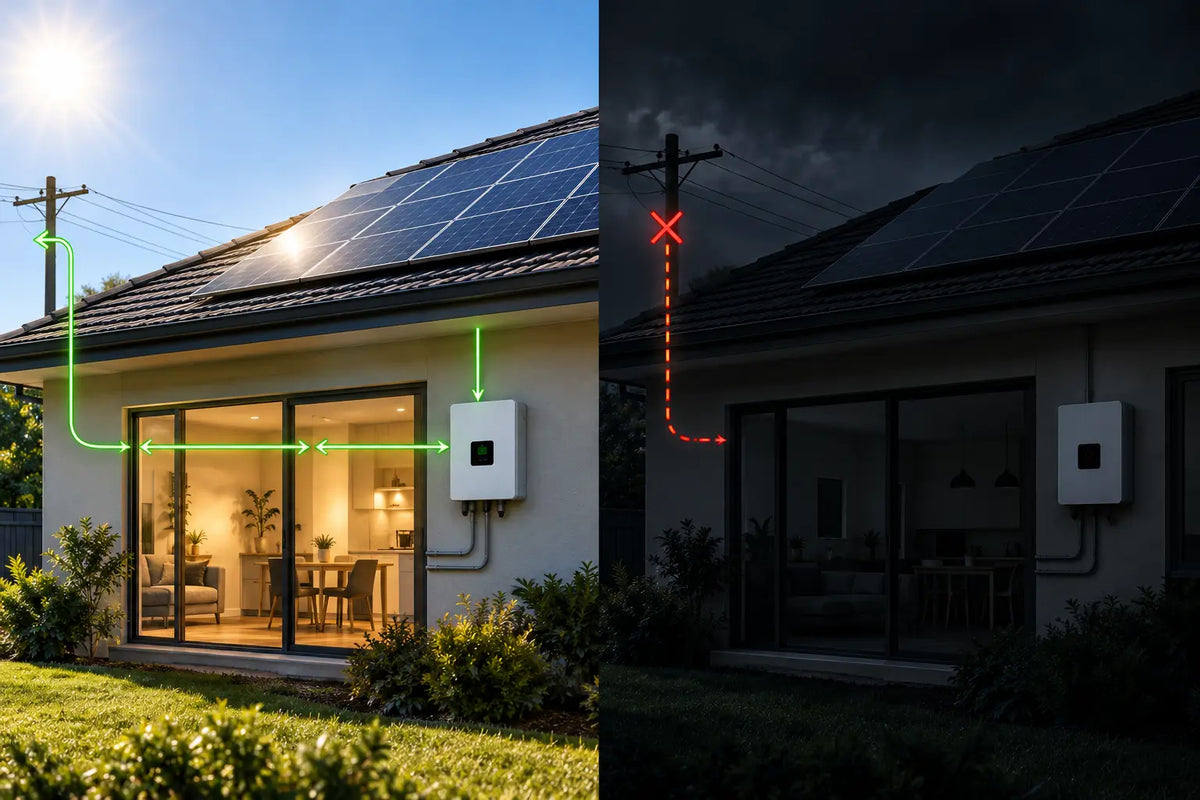
Blackout-Ready Before Storm Season: Your Home Battery Backup Checklist
Quick answer: With storm season approaching, now is the time to check whether your home actually has battery backup — because most solar systems, and many batteries, don't provide backup by default. Genuine home battery backup needs a backup-capable inverter and dedicated backup wiring, not just a battery on the wall. Rooftop solar on its own shuts down in a blackout for safety, so if keeping your fridge, lights and internet running through an outage matters, it needs to be set up before the first storm hits.
Every year, households discover during the first big outage that their solar or battery doesn't keep the lights on — because it was never configured to. The good news is that August, before storm season ramps up, is the ideal time to check and fix it. This guide is a practical checklist to get blackout-ready.
BESS Australia is an accredited, multi-brand supplier and installer of home battery systems and backup solutions, supplying Australia-wide and installing across Brisbane, the Sunshine Coast, the Gold Coast, Sydney and Melbourne.
Will my battery work in a blackout?
Your battery will only work in a blackout if it's set up for backup — with a backup-capable inverter and backup wiring. Many batteries don't provide backup by default, and rooftop solar on its own shuts down in an outage. Owning a battery isn't the same as having backup.
Standard grid-connected solar disconnects the moment the grid fails, due to a mandatory safety feature called anti-islanding that stops your system feeding power into the grid while it's down (protecting network workers). To keep running during an outage, you need a backup-capable inverter — or a separate backup device — plus wiring to the circuits you want powered. If you're not sure whether your system has this, that uncertainty is exactly what this pre-season check is for. You can see backup-capable options in our inverters range.
Why storm season is the time to check
Storm and blackout season ramps up from spring into summer across much of Australia, so the weeks beforehand are the time to check and fix your backup — not during the first outage. Getting ahead of the season avoids the scramble.
As the weather warms, storms, high winds and grid strain make outages more likely, particularly across NSW and South East Queensland. Installer demand also climbs toward summer, so booking any backup upgrade now means a smoother, faster job than waiting until everyone wants one at once. Preparation beats reaction.
Want to be blackout-ready? Get your backup checked or set up before storm season — call 1300 859 066, email sales@bessaustralia.com.au, or request a tailored quote.
Your storm-season backup checklist
To be blackout-ready, work through seven checks: confirm you have backup, know which circuits it covers, know what it can run, understand the switchover, check solar recharging, plan your essentials, and book any upgrade early. Here's the checklist:
-
Confirm you actually have backup. A battery alone isn't enough — check that your system has a backup-capable inverter and backup wiring.
-
Know which circuits are backed up. Is it selected essential circuits, or the whole home? You need to know what will and won't run.
-
Know what your battery can run. This depends on the inverter's continuous power output (kW) and the battery's stored energy (kWh).
-
Understand the switchover. Some systems switch to backup near-seamlessly; others have a brief drop. Know what to expect.
-
Check whether solar keeps generating in backup. Some systems keep your solar running during an outage, recharging the battery each day — valuable in multi-day outages.
-
Plan for your essentials. Identify the must-run loads: fridge, lights, internet, phone charging, and any medical equipment.
-
Book any upgrade before the season. If you don't have backup (or want more), arrange it now, before demand peaks.
What can a battery run during an outage?
A battery with backup can typically run essentials like your fridge, lights, internet and phone charging comfortably, while high-surge appliances such as air-conditioners, pumps and ovens need a system with enough continuous power and surge capacity. What it runs depends on the setup.
A battery doesn't power everything at once simply because it's charged — the inverter's continuous output and the battery's capacity set the limits. If you want specific appliances to run through an outage, list them before you buy or upgrade so the system is sized for them. Backup performance depends on your configuration and a site assessment, so it shouldn't be assumed.
A note on medical equipment: if anyone in your home relies on life-support or medical devices, don't rely on a battery alone. Keep a documented outage plan with your energy provider and medical team, as a battery is a helpful backup but not a guaranteed substitute for a medical power supply.
Essential-circuit vs whole-home backup
You can back up selected essential circuits, or your whole home — essential-circuit backup is more affordable, while whole-home backup needs a larger, more powerful system. Most households choose essential-circuit backup.
Essential-circuit backup wires the loads you most want running — fridge, lights, some power points, internet — to a dedicated backup circuit, which keeps costs down. Whole-home backup covers everything but needs a bigger inverter and battery to be useful, or high-demand appliances can drain it quickly. Which suits you comes down to what you need running and your budget, best worked out with an installer.
How do I prepare my home for storm season?
To prepare your home for storm season, confirm whether your system provides backup, identify your essential loads, and get any backup upgrade installed before the season starts. It comes down to checking, planning and acting early.
If you already have a backup-capable system, the job is mostly understanding it — which circuits are covered and what they can run. If you don't, the move is to add backup capability before storms arrive, through a solar-and-battery installation designed with backup in mind. Either way, the worst time to find out your system doesn't do backup is halfway through an outage.
Don't rely on solar alone
Solar panels on their own will not power your home in a blackout — they shut down for safety the moment the grid fails. This surprises many solar owners.
Because of anti-islanding, a grid-connected solar system disconnects in an outage even in bright sunshine. Only a battery with a proper backup configuration lets your home keep running safely off-grid during a blackout, and in some setups keeps your solar generating to recharge the battery. So if blackout resilience is a goal, solar alone won't deliver it — storage and a backup setup are what make the difference.
Getting backup set up right
Genuine backup depends on the system being designed, sized and wired correctly by an accredited installer — not on the battery brand alone. The setup is what determines whether it works when you need it.
An installer assesses your switchboard, your electrical phase (three-phase homes have extra considerations, as some systems back up only one phase), and the specific loads you want covered. BESS Australia installs using Solar Accreditation Australia-accredited installers, and you can check product approval and consumer guidance via the Clean Energy Council. A correctly designed system is what turns "I have a battery" into "my home stays on".
The rebate helps with a backup battery
A battery that provides blackout backup is also eligible for the federal battery rebate, which reduces the upfront cost. It's worth factoring into your timing before storm season.
The federal Cheaper Home Batteries Program provides a discount toward eligible battery installations, and that discount reduces over time through to 2030 — so acting sooner secures a better rate as well as getting you blackout-ready earlier. Eligibility depends on the product, install and current rules, which we'll confirm when we quote.
How BESS Australia gets you blackout-ready
BESS Australia is an accredited supplier and installer of home battery and backup systems, offering complete supply-and-install packages as well as equipment-only supply Australia-wide. We design backup around the appliances you actually need running, using an extensive range of tier-1 brands, and get it installed before the season so you're not caught out.
Our trust signals are straightforward: CEC-approved products, Smart Energy Council membership, the NETCC Approved Seller consumer-protection code, installation by Solar Accreditation Australia-accredited installers, manufacturer warranties, a workmanship warranty, and Australian Consumer Law protections. We also offer a Lowest Price Guarantee, finance options and rebate assistance. Backup performance depends on your configuration and site assessment, so we'll design and confirm it for your home rather than promise a fixed outcome.
Be ready before the first storm. Ask BESS Australia to check your backup or design a blackout-ready system now — call 1300 859 066, email sales@bessaustralia.com.au, or use our request a tailored quote form.
FAQ
Will my battery work in a blackout? Only if it's configured for backup. A battery needs a backup-capable inverter (or a separate backup device) and dedicated backup wiring to power your home during an outage — many batteries don't provide backup by default. Rooftop solar on its own shuts down in a blackout for safety, so backup must be specified and set up in advance.
How do I prepare my home for storm season? Confirm whether your system actually provides backup, identify which circuits and appliances you need running, and get any backup upgrade installed before the season starts. If you don't have backup, add it now while installer demand is lower. Knowing what your system can run before an outage — rather than during one — is the key.
What can a battery run during an outage? Typically essentials like your fridge, lights, internet and phone charging run comfortably. High-surge appliances such as air-conditioners, pumps and ovens need a system with enough continuous power and surge capacity. A battery doesn't run everything at once, so list your priority appliances before buying so it's sized correctly. Backup performance depends on your configuration.
Does solar keep working in a blackout? Not on its own. Grid-connected solar shuts down the moment the grid fails, due to a mandatory safety feature called anti-islanding. Only a battery with a proper backup configuration lets your home keep running during an outage, and some setups keep the solar generating to recharge the battery. Solar alone won't provide blackout protection.