
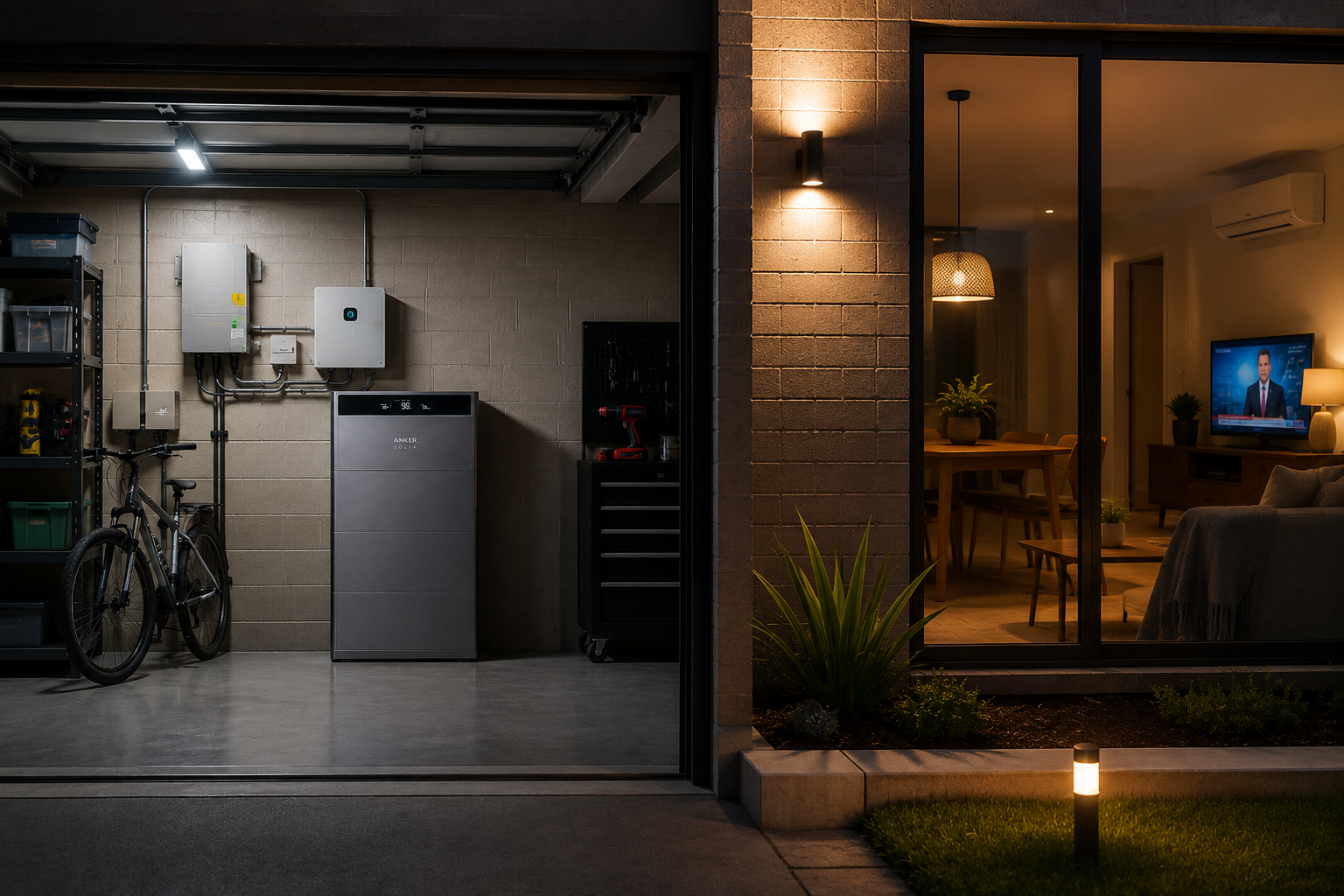
Quick answer: A solar battery only powers your home during a blackout if it's set up for backup — with a backup-capable inverter and dedicated backup wiring. Many home batteries do not provide backup by default, and rooftop solar on its own shuts down in an outage for safety. With the right configuration, a solar battery backup can keep essential appliances like your fridge, lights and internet running, but exactly what it powers and for how long depends on the system and your usage.
It's one of the most common and costly misunderstandings in home energy: assuming any battery means the lights stay on when the grid goes down. This guide explains why that's not automatic, what you actually need for blackout backup, what a battery can run, and how to get a system that does what you expect when it matters.
BESS Australia is an accredited, multi-brand supplier and installer of home battery systems, supplying equipment Australia-wide and installing across Brisbane, the Sunshine Coast, the Gold Coast, Sydney and Melbourne.
Will my solar battery work during a blackout?
Your solar battery will only work during a blackout if it has been specifically configured for backup — a battery alone doesn't guarantee it. Backup capability comes from how the system is designed and wired, not just from owning a battery.
Two things have to be in place. First, a backup-capable inverter (or a separate backup device) that can run your home independently of the grid. Second, backup wiring that connects the loads you want to keep running. Without both, your battery may sit idle during an outage even though it's full of charge. If blackout protection matters to you, it needs to be specified up front — which is why a site assessment is the right starting point.
Why solar panels alone stop working in a blackout
Standard grid-connected solar shuts down within moments of a blackout because of a safety feature called anti-islanding, which prevents your system from feeding power into the grid while it's down. This protects electricity workers who may be repairing the network.
Anti-islanding is the automatic disconnection of a grid-connected system when the grid loses power. It's a mandatory safety function — so without a battery and backup setup, your solar panels stop generating the instant the grid fails, even in bright sunshine. A correctly configured battery system is what allows your home to keep running safely "off-grid" during the outage and, in some setups, lets your solar keep generating to recharge the battery.
What you need for solar battery backup
Blackout backup requires three things working together: a backup-capable inverter, a battery with enough stored energy, and dedicated backup circuit wiring. Leave one out and the backup won't function as expected.
Here's what each part does:
- A backup-capable (usually hybrid) inverter or backup gateway. A hybrid inverter manages both solar and battery and, when backup-rated, can power your home during an outage. Some systems use a separate "backup gateway" or changeover device that isolates your home from the grid and switches to battery power.
- A battery sized for the job. Backup needs enough usable capacity (kWh) to last the outage, and the inverter needs enough continuous power output (kW) to run your chosen loads at once.
- Backup circuit wiring. This is where an installer wires the appliances you want backed up — either a selected "essential" circuit or your whole switchboard — so power flows to them when the grid is down. These backup circuit requirements are part of the install, not an afterthought.
The switchover itself is usually fast: many backup systems transfer to battery power in a fraction of a second, and some are near-seamless, though brief drops can occur depending on the system.
Want peace of mind for the next outage? Get a backup-ready battery system designed for your home — call 1300 859 066, email sales@bessaustralia.com.au, or request a tailored quote.
Essential-circuit backup vs whole-home backup
There are two main approaches to blackout backup: backing up selected essential circuits, or backing up the whole home — the right choice depends on your budget and what you need to keep running. Most households choose essential-circuit backup because it's more cost-effective.
|
Essential-circuit (backup) |
Whole-home backup |
|
|
What it powers |
Selected circuits — e.g. fridge, lights, power points, internet |
Most or all of the home's circuits |
|
Wiring |
A dedicated backup circuit or sub-board |
The whole switchboard via a backup gateway |
|
Inverter size needed |
Smaller continuous output |
Larger continuous output plus surge capacity |
|
Typical cost (AUD) |
Lower |
Higher |
|
Best for |
Keeping must-have loads running affordably |
Homes wanting near-normal power in an outage |
|
Watch-outs |
High-surge appliances may exceed capacity |
Big loads (air-con, EV charging) can drain the battery fast |
Whole-home backup sounds ideal, but it needs a larger, more powerful inverter and a bigger battery to be useful — otherwise high-demand appliances can flatten the battery quickly. An installer can help you weigh the trade-off against your real priorities.
What appliances can a home battery run during a blackout?
A home battery can typically run low- and medium-draw appliances — fridge, lights, internet, phone charging, TV — during a blackout, while high-surge appliances like air-conditioners, ovens and pool pumps need a system with enough continuous power and surge headroom. Two figures decide this: the inverter's continuous power output (kW) and the battery's stored energy (kWh).
|
Load type |
Typical examples |
Backup-friendly? |
|
Low draw |
LED lights, wifi/modem, phone and laptop charging, TV |
Yes — easily |
|
Medium draw |
Fridge/freezer, small kitchen appliances, selected power points |
Usually, with adequate inverter output |
|
High surge |
Air-conditioner, oven, induction cooktop, pool pump, EV charging |
Only with enough continuous and surge capacity |
The key point: a battery doesn't run everything at once just because it's charged. If running specific appliances through an outage matters — a medical device, a second fridge, or air-conditioning in summer — list them before you buy so the system is sized for it. Backup performance depends on your configuration and a proper site assessment, so it shouldn't be assumed.
Do I need a special inverter for backup power?
Yes — backup power needs a backup-capable inverter or a dedicated backup device, because a standard grid-connected inverter is designed to shut down in an outage. Not every battery or hybrid inverter automatically provides backup, so it's important to confirm the specific model and configuration support it.
Backup-capable systems come in different forms: some hybrid inverters have built-in backup output, while others rely on an added gateway or changeover unit. Brands vary in how they do this and how much power they can deliver off-grid, which is why matching the inverter to your backup goals matters. Our GoodWe battery and inverter range includes backup-capable options, and our team can advise which configuration suits your home.
How long will the backup last?
How long a battery backup lasts depends on your battery's usable capacity, how much power you're drawing, and whether your solar can keep generating during the outage to recharge it. A modest, well-managed load can stretch a battery much further than running everything at once.
As a general guide rather than a guarantee: a household running only essentials (fridge, lights, internet, charging) draws far less than one running air-conditioning or cooking, so the same battery could last anywhere from a few hours to most of a day depending on the load. Critically, some backup-capable systems keep your solar running during a blackout, so the battery tops up each day — which can extend backup across a multi-day outage. Whether your system can do this depends on its design, so confirm it if extended outages are a concern in your area.
Single-phase vs three-phase backup
On three-phase homes, backup can be more complex, because some systems only back up one of the three phases during an outage. Most Australian homes are single-phase, where backup is generally more straightforward.
If you have a three-phase property, it's worth checking which appliances sit on which phase, since loads wired to a non-backed-up phase won't run in an outage. This is exactly the kind of detail that a site assessment resolves before installation, so the appliances you care about end up on the backed-up supply.
Getting it right: sizing and installation
The difference between a battery that "has a battery" and one that reliably keeps your home running in a blackout is in the design, sizing and installation — not the brand alone. A backup system has to be matched to the loads you want, the power they draw, and how your switchboard is wired.
This is why backup should be installed by accredited professionals. BESS Australia uses installers accredited under Solar Accreditation Australia, and we'll assess your home's wiring, phase and priorities before recommending a configuration — so the system does what you expect when the grid goes down.
How BESS Australia sets up reliable backup
BESS Australia is an accredited supplier and installer of home battery and backup systems, offering complete supply-and-install battery packages as well as equipment-only supply Australia-wide. We carry an extensive range of tier-1 brands — including GoodWe, Fox ESS, Sigenergy, Tesla, BYD and Sungrow — under one roof, so your backup setup is matched to your home rather than to a single manufacturer.
Our trust signals are straightforward: CEC-approved products (you can check product approval and consumer guidance via the Clean Energy Council), Smart Energy Council membership, the NETCC Approved Seller consumer-protection code, installation by Solar Accreditation Australia-accredited installers, manufacturer warranties, a workmanship warranty, and Australian Consumer Law protections. We also offer a Lowest Price Guarantee, finance options and rebate assistance — the Australian Government's Cheaper Home Batteries Program provides a discount toward eligible battery installations, and that discount reduces over time through to 2030, so it's worth getting advice sooner. Eligibility depends on the product, install and current rules.
Don't get caught in the dark. Ask BESS Australia to design a backup system around the appliances you actually need — call 1300 859 066, email sales@bessaustralia.com.au, or use our request a tailored quote form. We'll assess your home and recommend a configuration sized for real blackout protection.
FAQ
Will my solar battery work during a blackout? Only if it's configured for backup. A battery needs a backup-capable inverter (or a separate backup device) and dedicated backup wiring to power your home in an outage — many batteries don't provide backup by default. Rooftop solar on its own shuts down in a blackout for safety, so backup must be specified when you buy.
What appliances can a home battery run during a blackout? Typically low- and medium-draw appliances — fridge, lights, internet, phone charging and TV — run comfortably. High-surge appliances like air-conditioners, ovens, pool pumps and EV charging need a system with enough continuous power and surge capacity. A battery doesn't run everything at once, so list your priority appliances before buying so it's sized correctly.
Do I need a special inverter for backup power? Yes. Backup requires a backup-capable inverter or a dedicated backup gateway, because a standard grid-connected inverter is designed to shut down during an outage for safety. Not every hybrid inverter provides backup automatically, so confirm that the specific model and configuration support it before you commit to a system.
How long does a solar battery last in a blackout? It depends on your battery's usable capacity, your power draw, and whether your solar keeps generating to recharge it. Running only essentials can stretch a battery from a few hours to most of a day, and systems that keep solar active during an outage can extend backup across multiple days. Estimates depend on your setup.