
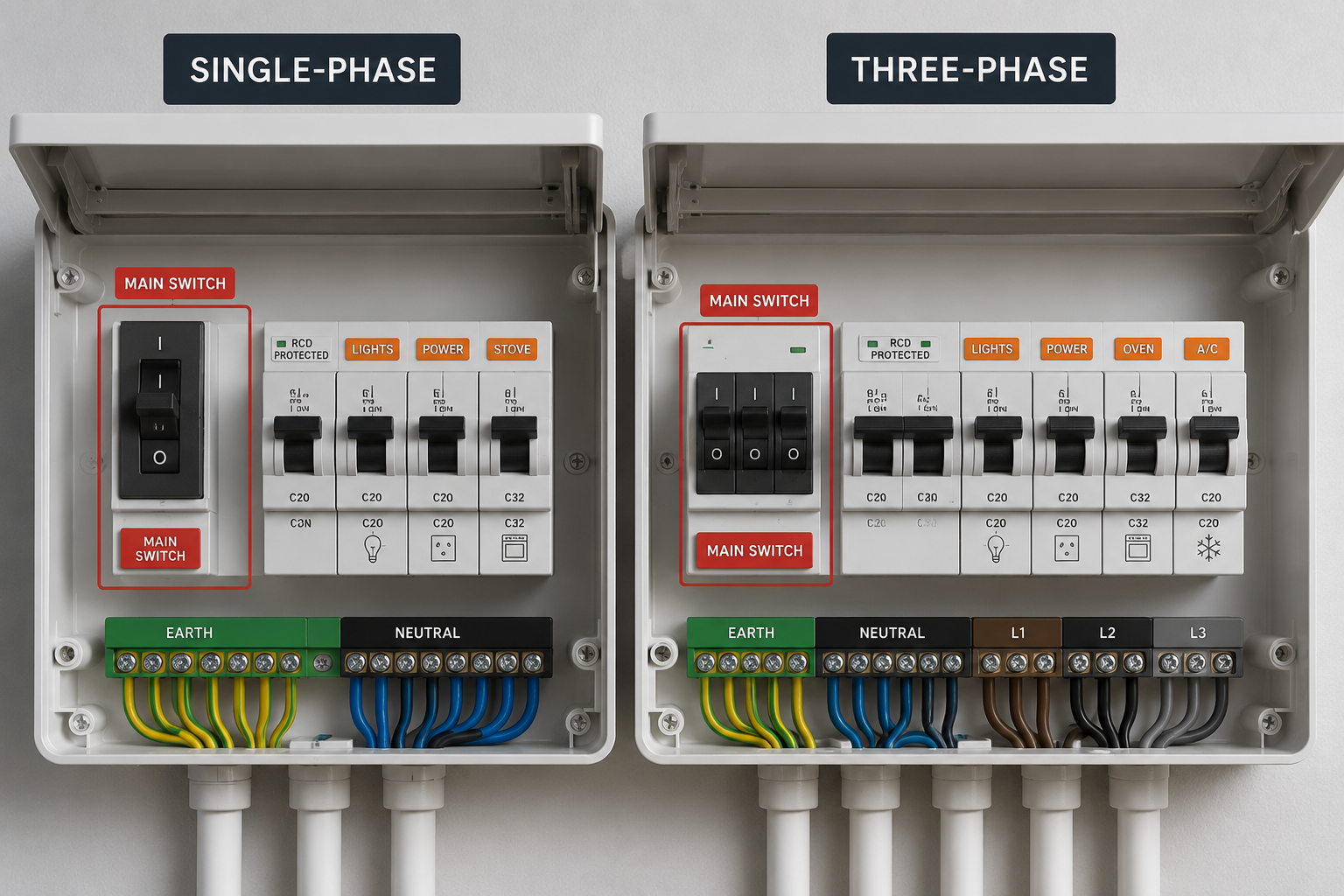
Quick answer: No — a three-phase home doesn't automatically need a three-phase battery. A single-phase battery can be installed on a three-phase property by connecting to one of its phases, and for many homes that's a perfectly good, lower-cost choice. The single-phase vs three-phase battery decision really comes down to your home's electrical supply, whether you run large three-phase appliances, and how much of your home you want backed up during a blackout.
Phase confusion is one of the most common reasons buyers end up with the wrong system or pay for capacity they don't need. This guide explains the difference between single-phase and three-phase power, how to tell which your home has, and how to choose the right battery for your property.
BESS Australia is an accredited, multi-brand supplier and installer of home battery systems, supplying equipment Australia-wide and installing across Brisbane, the Sunshine Coast, the Gold Coast, Sydney and Melbourne.
What's the difference between single-phase and three-phase power?
Single-phase power delivers electricity through one active conductor, while three-phase power uses three — letting a three-phase supply deliver more power at once. Most Australian homes are single-phase; larger homes and properties with heavy electrical loads are more often three-phase.
A phase is essentially a separate live supply line bringing power into your home. A single-phase home has one; a three-phase home has three, which is why three-phase supply suits properties running big simultaneous loads like ducted air-conditioning, pool equipment, workshops or three-phase EV charging. Neither is "better" in general — they're simply different supply types, and your battery needs to suit the one you have.
How can I tell what electrical phase my house has?
The easiest way to tell your home's phase is to look at the main switch in your switchboard: a single, narrower main switch usually indicates single-phase, while a wider main switch made of three linked switches indicates three-phase. The most reliable confirmation, though, comes from a licensed electrician.
Here are the practical checks:
- Look at the main switch. One main switch (single or double pole) generally means single-phase; a main switch spanning three connected poles generally means three-phase.
- Count the active wires at the meter. One active conductor suggests single-phase; three suggests three-phase — but never open or tamper with the meter or switchboard yourself.
- Consider your appliances. Some ducted air-conditioners, pool pumps and workshop equipment are three-phase, which hints at a three-phase supply.
- Ask a professional. A licensed electrician, or your network distributor or retailer, can confirm your phase definitively and safely.
If you're unsure, an installer confirms your phase as part of a site assessment before recommending any system — so you never have to guess.
Can a single-phase battery work on a three-phase home?
Yes — a single-phase battery can be installed on a three-phase home by connecting to one of the three phases, and it's a common, cost-effective setup. What it can and can't do across the other phases is the part worth understanding.
For billing, whether a single-phase battery offsets your whole-home consumption (not just the phase it sits on) depends on your meter and your local network rules — most modern smart meters net usage across the whole site, but this varies, so confirm it with your installer. For backup, a single-phase battery generally powers only the circuits on its phase during an outage, so appliances on the other phases won't run unless the system is designed differently. These are exactly the details a site assessment clarifies before you buy.
Not sure which phase setup suits your home? Get a phase-correct battery recommendation from BESS Australia — call 1300 859 066, email sales@bessaustralia.com.au, or request a tailored quote.
Do I need a three-phase solar battery?
You need a three-phase solar battery only if you want to back up three-phase appliances, run large simultaneous loads, or have whole-home three-phase backup — otherwise a single-phase battery is often enough. Having a three-phase supply alone isn't a reason to pay for a three-phase battery.
Ask yourself three questions: Do you run three-phase appliances you'd want working in a blackout? Do you draw very high power simultaneously across the home? Do you want backup across all three phases rather than one? If the answer to those is "no," a single-phase battery on your three-phase home is frequently the more sensible, lower-cost option. If "yes," a three-phase system is worth considering.
Single-phase vs three-phase battery: a side-by-side
Single-phase batteries are lower-cost and suit most homes; three-phase batteries cost more but support three-phase loads and whole-home three-phase backup. The table below summarises the trade-offs.
|
Single-phase battery |
Three-phase battery |
|
|
Best suited to |
Most homes; single-phase supply, or three-phase homes without large three-phase loads |
Three-phase homes with big or three-phase appliances, or wanting whole-home three-phase backup |
|
Typical cost (AUD) |
Lower |
Generally higher |
|
On a three-phase home |
Connects to one phase; may offset whole-home usage for billing depending on metering and network rules |
Works across all three phases |
|
Backup in an outage |
Backs up loads on its phase |
Can back up across all three phases (configuration-dependent) |
|
Three-phase appliances |
Won't run on single-phase backup |
Can support three-phase loads |
Cost and capability both matter here, so the right answer is the system that matches your loads and backup goals — not simply the bigger one.
When a three-phase battery makes sense
A three-phase battery makes sense when your home runs significant three-phase loads or you want full three-phase backup. These setups deliver more power across the home and can keep three-phase appliances running in an outage.
Typical scenarios include homes with three-phase ducted air-conditioning, three-phase pool or spa equipment, a workshop, or three-phase home EV charging where you want fast charging without stressing a single phase. If whole-of-home backup including those loads is a priority, a three-phase battery and inverter is the configuration built for it. Brands like Fox ESS and GoodWe offer three-phase hybrid options — you can browse our Fox ESS hybrid inverter range for examples.
When a single-phase battery is the better choice
For most Australian homes, a single-phase battery is the better choice — it's lower-cost and well-matched to the way typical households use power. This holds true even for many three-phase homes that don't run large three-phase loads.
A hybrid inverter — an inverter that manages both solar and battery — is available in single-phase versions that cover the needs of the majority of households comfortably. If your evening usage, backup priorities and appliances all sit comfortably within a single-phase setup, paying for three-phase capability you won't use rarely makes sense. The goal is the right fit, not the biggest spec.
Battery inverter phase compatibility
Battery inverter phase compatibility matters: the inverter must be matched to your supply and your intended backup setup — you can't simply connect a three-phase battery to a single-phase supply, or expect single-phase backup to power three-phase appliances. Getting this wrong is exactly what leads to disappointed buyers.
This is why phase should be confirmed and the system designed before purchase, by accredited professionals. BESS Australia installs using installers accredited under Solar Accreditation Australia, and you can check product approvals and consumer guidance via the Clean Energy Council. A correctly matched inverter, battery and switchboard is what makes the system behave the way you expect.
Getting the phase decision right
The phase decision should be made after a site assessment that confirms your supply, your loads, your metering and your backup priorities — not from a spec sheet alone. Your network's rules can also influence how a battery is metered and what's permitted, which an installer factors in.
This is genuinely a case where professional advice saves money: it prevents both over-buying a three-phase system you don't need and under-specifying a single-phase one that won't back up what matters to you.
How BESS Australia helps you choose the right phase
BESS Australia is an accredited supplier and installer of single-phase and three-phase home battery systems, offering complete supply-and-install battery packages as well as equipment-only supply Australia-wide. We carry an extensive range of tier-1 brands — including GoodWe, Fox ESS, Sigenergy, Tesla, BYD and Sungrow — in both single- and three-phase configurations, so your system is matched to your supply rather than to whatever a single brand stocks.
Our trust signals are straightforward: CEC-approved products, Smart Energy Council membership, the NETCC Approved Seller consumer-protection code, installation by Solar Accreditation Australia-accredited installers, manufacturer warranties, a workmanship warranty, and Australian Consumer Law protections. We also offer a Lowest Price Guarantee, finance options and rebate assistance — the Australian Government's Cheaper Home Batteries Program provides a discount toward eligible battery installations, and that discount reduces over time through to 2030, so it's worth getting advice sooner. Eligibility depends on the product, install and current rules.
Get the phase right the first time. Ask BESS Australia to confirm your supply and recommend the correct battery for your home — call 1300 859 066, email sales@bessaustralia.com.au, or use our request a tailored quote form. We'll assess your phase, loads and backup goals, then match a system that fits.
FAQ
Do I need a three-phase solar battery? Only if you want to back up three-phase appliances, run very high simultaneous loads, or have whole-home three-phase backup. Having a three-phase supply alone isn't a reason to buy a three-phase battery — many three-phase homes are well served by a lower-cost single-phase battery. A site assessment confirms what suits your loads and backup goals.
Can a single-phase battery work on a three-phase home? Yes. A single-phase battery connects to one of the three phases and is a common, cost-effective setup. Whether it offsets whole-home usage for billing depends on your metering and network rules, and for backup it generally powers only the circuits on its phase. Your installer confirms these details before installation.
How can I tell what electrical phase my house has? Look at your switchboard's main switch: one narrower main switch usually means single-phase, while a wider switch of three linked poles means three-phase. You can also count the active wires at the meter, but never tamper with it. The most reliable check is to ask a licensed electrician, retailer or network distributor.
Is a three-phase battery more expensive than a single-phase one? Three-phase battery and inverter systems generally cost more than single-phase equivalents, because they deliver more power and can support three-phase loads and backup. Whether the extra cost is worthwhile depends on your appliances and backup priorities. For many homes without large three-phase loads, a single-phase battery offers better value. Costs are estimates that depend on your setup.