
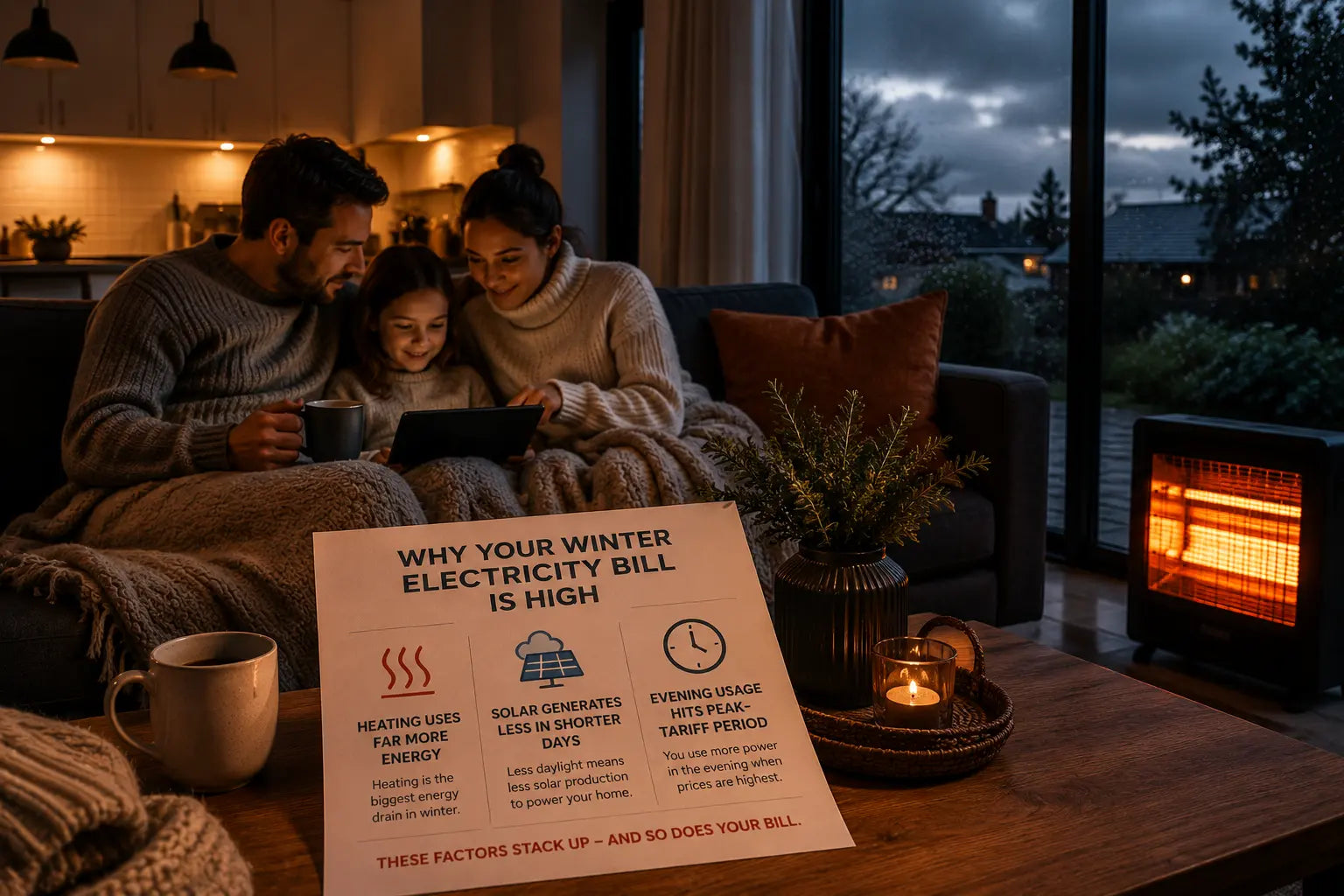
Why Your Winter Electricity Bill Spiked — and How to Reduce It
Quick answer: A high winter electricity bill usually comes down to three things: heating uses far more energy than any other household load, your solar generates less over the shorter winter days, and your heavy evening usage falls in the most expensive peak-tariff window. Solar and a battery reduce a winter bill by covering more of your usage with your own energy — especially by storing daytime solar to run your evening heating instead of buying peak-priced grid power.
If your latest bill made you wince, you're not imagining it — winter is when household electricity costs peak for most Australian homes. The good news is that the reasons are predictable, and there are clear ways to cut them. This guide explains exactly why your bill jumped, and how solar and storage change the picture.
BESS Australia is an accredited, multi-brand supplier and installer of solar panels and home battery systems, supplying Australia-wide and installing across Brisbane, the Sunshine Coast, the Gold Coast, Sydney and Melbourne.
Why is my winter electricity bill so high?
Your winter electricity bill is high mainly because heating is energy-intensive, your solar produces less in the shorter days, and your evening usage lands in the peak-tariff period. Several seasonal factors stack up at once.
Here are the main causes:
-
Heating. Reverse-cycle air-conditioning and heaters are among the most energy-hungry things in your home, and they run for hours in winter.
-
Less solar. Shorter, cloudier days mean your panels generate less, so you buy more from the grid.
-
Longer evenings on peak tariffs. Heating, lighting and cooking cluster in the expensive evening peak, when grid power costs the most.
-
Hot water. Colder incoming water means your hot-water system works harder to heat it.
-
More time indoors. Lights, screens and appliances all run longer through the darker months.
Heating is the biggest driver
Heating is typically the single biggest reason a winter bill jumps, because it draws a lot of power and runs during the priciest part of the day. The timing is what really hurts.
A time-of-use tariff charges different rates at different times, with a high "peak" rate in the evening — exactly when your heating, lights and cooking all run in winter. So you're not just using more energy; you're using it when each unit costs the most. That combination of higher volume and higher rate is what pushes the bill up sharply compared with milder months.
Less solar in winter means you buy more from the grid
In winter, your solar panels generate less — often around half of their summer output on the shortest days — so more of your usage is met by grid power you pay for. Shorter days and a lower sun angle reduce generation.
This is why solar-only homes can still see winter bills climb: the panels simply produce less at the time of year you need the most. Self-consumption — using your own solar rather than exporting it — drops in winter because there's less surplus, and what you do export by day is paid at a low feed-in rate while you buy power back at peak rates in the evening. A well-sized array of quality solar panels helps capture more of that shorter winter window.
Tired of high winter bills? See how solar and a battery could cut yours — call 1300 859 066, email sales@bessaustralia.com.au, or request a tailored quote.
Can solar reduce my winter bill?
Yes — solar reduces your winter bill by offsetting your daytime usage, though it does less in winter than summer because generation is lower. Solar alone is a strong start, but it leaves your evening heating peak exposed.
The value of solar in winter is real but front-loaded to daylight hours: it covers daytime loads like hot water, a load of washing or a heat pump running on a timer. What it can't do on its own is power your evening heating, because the panels have stopped generating by then. That's the gap a battery fills — which is why solar and storage together do far more for a winter bill than solar alone.
Does a battery help in winter?
Yes — a battery can be especially valuable in winter, because it stores the limited daytime solar you generate and releases it during the expensive evening heating peak. It shifts your costliest usage off peak-priced grid power.
A battery stores your daytime surplus so you can use it after dark. In winter, that means running your evening heating, lighting and cooking on stored solar instead of buying at peak rates — precisely the usage that inflates your bill. Even though there's less solar to store in winter, capturing it and using it in the peak window is where the savings are. Pairing panels with a home battery is the most effective way to attack a winter bill.
Hot water and heating: the efficiency angle
Switching to heat-pump hot water can cut a major slice of your winter energy use, because a heat pump is typically around three to four times more efficient than a standard electric element. Hot water is one of the biggest winter loads.
A heat-pump hot-water system uses a heat pump to heat water far more efficiently than a conventional electric element, and running it on daytime solar makes it cheaper still. Since heating water takes more energy in winter (the incoming water is colder), this is one of the highest-value efficiency upgrades for cutting a winter bill. You can see options in our heat-pump hot water range.
How much can solar and a battery cut your winter bill?
Solar and a battery can substantially reduce a winter bill, but the exact saving depends on your household, usage, tariff and system size — so any figure is an estimate, not a guarantee. The homes that save most have high evening heating use and a battery sized to cover it.
To understand your own bill, it helps to check your usage and tariff first — the AER's free Energy Made Easy tool lets you compare plans and see where your costs come from. From there, a system sized to your winter evening load gives you a realistic saving estimate. The only reliable number is one modelled against your actual consumption.
Right-size for winter, not just summer
Size your solar and battery to your winter evening load — your toughest month — rather than your gentlest summer day, so the system still performs when your bills are highest. Under-sizing to summer usage is a common mistake.
Because winter is when generation is lowest and heating demand is highest, it's the season that should drive your sizing. A battery matched to your winter evening usage, paired with enough solar and a battery-ready hybrid inverter, keeps you covered year-round. A site assessment works out what your home actually needs across the seasons.
The rebate helps with the battery cost
The federal battery rebate reduces the upfront cost of adding storage, making a winter-bill-cutting battery more affordable now. It's worth factoring into your timing.
The federal Cheaper Home Batteries Program provides a discount toward eligible battery installations, and that discount reduces over time through to 2030 — so acting sooner secures a better rate. Eligibility depends on the product, install and current rules, which we'll confirm when we quote.
How BESS Australia helps you cut winter bills
BESS Australia is an accredited supplier and installer of solar, battery and heat-pump systems, offering complete supply-and-install packages as well as equipment-only supply Australia-wide. Because we carry an extensive range of tier-1 brands under one roof and cover solar, storage and hot water, we can build a system that targets the specific loads driving your winter bill.
Our trust signals are straightforward: CEC-approved products, Smart Energy Council membership, the NETCC Approved Seller consumer-protection code, installation by Solar Accreditation Australia-accredited installers, manufacturer warranties, a workmanship warranty, and Australian Consumer Law protections. We also offer a Lowest Price Guarantee, finance options and rebate assistance. Any savings we discuss are estimates that depend on your household, usage and tariff — never guarantees.
Stop dreading the winter bill. Ask BESS Australia to model how solar and a battery could reduce yours — call 1300 859 066, email sales@bessaustralia.com.au, or use our request a tailored quote form.
FAQ
Why is my winter electricity bill so high? Winter bills spike mainly because heating is energy-intensive and runs for hours, your solar generates less over shorter days so you buy more from the grid, and your heavy evening usage falls in the peak-tariff window. Hot water also works harder in winter. Together, higher usage and higher evening rates push the bill up sharply.
Can solar reduce my winter bill? Yes, though it does less in winter than summer because generation is lower. Solar offsets your daytime usage — hot water, appliances, a heat pump on a timer — but on its own it can't power your evening heating, since the panels have stopped generating by then. Pairing solar with a battery covers that evening gap.
Does a battery help in winter? Yes, and it can be especially valuable. A battery stores the limited daytime solar you generate and releases it during the expensive evening heating peak, shifting your costliest usage off peak-priced grid power. Even with less solar to store in winter, using it in the peak window is where the savings are. Actual savings depend on your usage.
How much can solar and a battery cut my winter bill? It can be substantial, but the exact saving depends on your household, usage, tariff and system size, so any figure is an estimate rather than a guarantee. Homes with high evening heating use and a battery sized to cover it tend to save most. A quote modelled against your actual consumption gives a realistic number.