
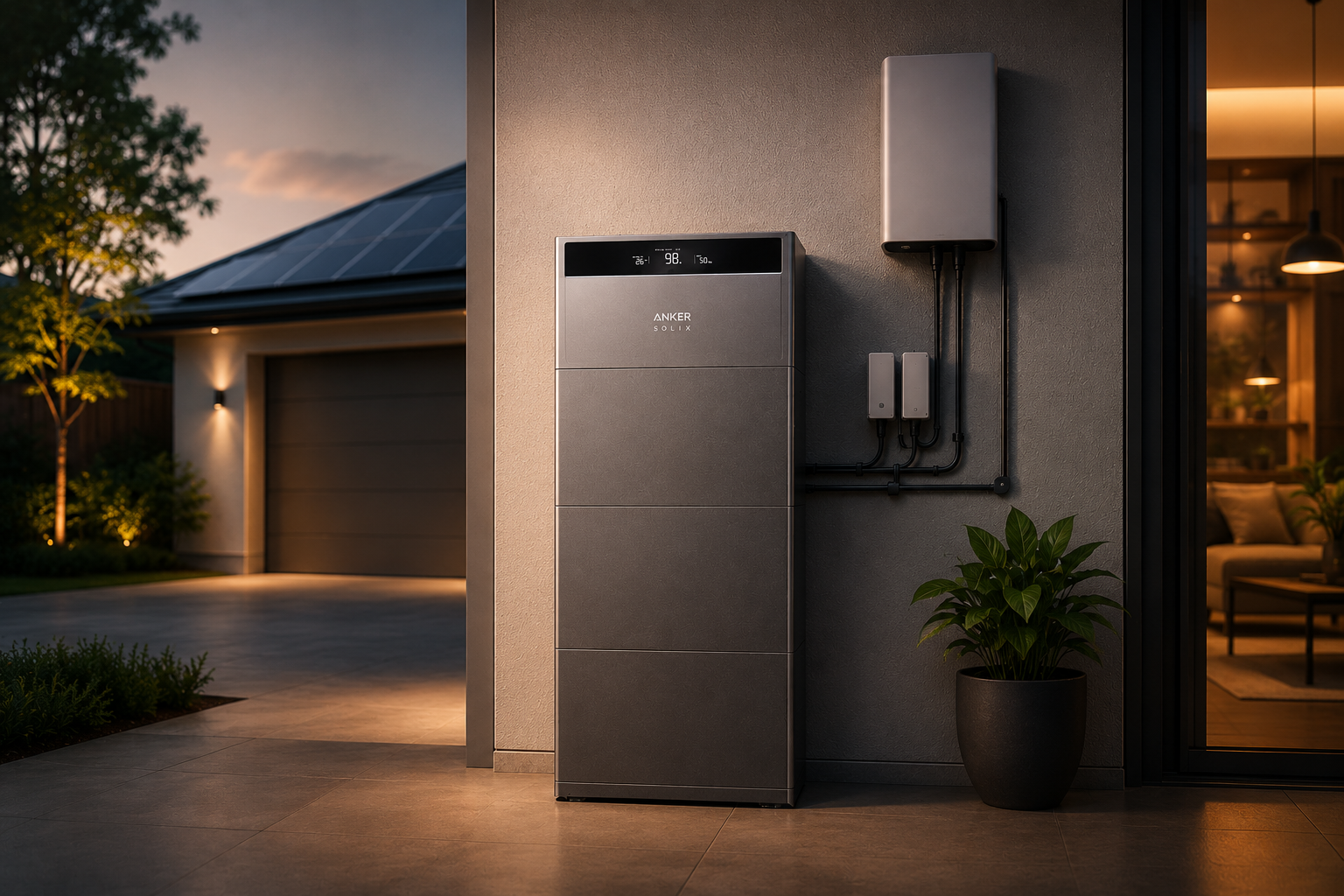
How Solar Batteries Cut Your Electricity Bills
Quick answer: A solar battery reduces your electricity bills by storing the cheap daytime solar your panels generate so you can use it at night, instead of buying expensive grid power after dark. The size of your solar battery savings depends on your tariff, your after-dark usage, your solar system and your battery — but for many Australian homes, a battery lifts how much of their own solar they use from around a third to most of it.
If you have panels and your bills are still high, you're not alone — and a battery is usually the missing piece. This guide explains exactly how stored solar saves money, how much you might save, and how to tell whether a battery is worth it for your household.
BESS Australia is an accredited, multi-brand supplier and installer of home battery systems, with supply-and-installation across Brisbane, the Sunshine Coast, the Gold Coast, Sydney and Melbourne, and equipment supplied Australia-wide.
One term to know first: self-consumption
Self-consumption is the share of your solar energy that you use yourself rather than exporting to the grid. It's the single biggest lever on your bill. Without a battery, solar you don't use during the day is exported for a low feed-in rate; with a battery, that same energy is stored and used at night in place of grid power you'd otherwise pay full price for.
Why do I still have high bills with solar panels?
You can still get high bills with solar because your panels produce most of their power during the day, while a lot of your usage happens in the morning and evening when the panels aren't generating. That mismatch sends you back to the grid at exactly the times power is most expensive.
There's a second reason: the gap between what you're paid to export and what you pay to import. A feed-in tariff — the rate your retailer pays for solar you export — is commonly only a few cents per kilowatt-hour, while grid electricity you buy back in the evening often costs many times more. So every unit of solar you export by day and replace with grid power by night is a poor trade. A battery closes that gap by keeping your solar on your side of the meter.
How does stored solar energy save money?
Stored solar saves money by replacing expensive grid electricity with solar you already generated for free, shifting your usage from peak-priced grid power to your own stored energy. In practice, the battery charges from surplus solar during the day, then discharges in the evening and overnight to run your home.
The value comes from the price difference. As a rough illustration of the mechanism — not a guarantee for your home — a household that would otherwise export solar at a low feed-in rate and buy it back at a much higher evening rate captures that spread on every kilowatt-hour the battery shifts. The bigger the gap between your import and export rates, and the more energy you use after dark, the more a battery is worth. To check your own rates, you can compare plans on the Australian Government's Energy Made Easy tool.
Curious what a battery could do for your bill? Get an estimate based on your actual energy use — call 1300 859 066, email sales@bessaustralia.com.au, or request a tailored quote.
How much can a solar battery reduce my electricity bill?

A solar battery can reduce the grid-power portion of your bill substantially, but the exact saving depends on your tariff, usage pattern, solar size and battery size — so any figure should be treated as an estimate, not a guarantee. Households with high evening usage, a time-of-use tariff and a low feed-in rate tend to see the largest reductions, because they have the most expensive grid power to displace.
The honest answer is that two homes with identical batteries can save very different amounts. What matters is how much of your evening and overnight usage the battery actually covers with stored solar. The table below shows the factors that push your savings up or down.
|
Factor |
Smaller savings |
Larger savings |
|
Tariff type |
Flat-rate tariff |
Time-of-use tariff with high peak rates |
|
Feed-in tariff |
High feed-in rate |
Low feed-in rate (more reason to store) |
|
Evening/overnight usage |
Low after-dark use |
High after-dark use |
|
Solar generation |
Small array, little daytime surplus |
Larger array with surplus to store |
|
Battery size |
Too small to cover the evening |
Right-sized to your load |
|
Self-consumption before battery |
Already high |
Low — lots of exported solar to capture |
Because the numbers hinge on your household, the most reliable estimate comes from looking at your real consumption data rather than a generic average.
Use solar power at night by maximising self-consumption
To use solar power at night, you store your daytime surplus in a battery and draw on it after sunset — this is how a battery maximises your self-consumption. Many solar homes without storage self-consume only around a third of what their panels produce; with a correctly sized battery, that figure can rise to most of their generation.
Lifting self-consumption is where the savings live, because every unit you self-consume is a unit you don't buy from the grid. It also means you're no longer giving away surplus solar for a low feed-in rate during the day and buying it back at a premium at night. If you don't yet have panels — or your array is small — pairing storage with the right solar panels gives the battery enough surplus to charge from.
Battery storage and peak electricity rates
A battery cuts your exposure to peak electricity rates by powering your home from stored solar during the most expensive grid periods. A time-of-use tariff charges different prices at different times of day — typically a high "peak" rate in the evening, a lower "shoulder" rate, and a cheap "off-peak" rate overnight.
For homes on time-of-use plans, the evening peak is usually the costliest window — and it's also when solar generation has dropped off. A battery is most valuable here: it discharges through the peak so you avoid buying grid power at its highest price, then can recharge from solar the next day. If your retailer offers high evening peak rates, a battery's savings tend to be larger, all else being equal.
Is a solar battery worth it for savings?
Whether a solar battery is worth it for savings depends on your bill, your tariff and your usage — it's strongly worth considering if you have high evening usage, a low feed-in rate and a solar surplus you're currently exporting cheaply. A battery's payback (the time for energy savings to offset the upfront cost) is an estimate that varies household to household, so it's worth modelling against your real numbers rather than a rule of thumb.
Rebates can improve the maths. The Australian Government's Cheaper Home Batteries Program provides a discount toward eligible battery installations, and the discount reduces over time through to 2030 — so getting accurate advice sooner can be worthwhile. Eligibility depends on the approved product, the installation and the current program rules, which we'll confirm for your situation rather than promising a fixed amount. Finance is also available as an option to spread the upfront cost; we'd recommend confirming the terms before you commit.
Beyond the bill: the other ways a battery pays off
A battery's value isn't only the bill saving — it can also provide blackout backup, more energy independence and a way to power growing loads like an EV from your own solar. Backup capability depends on the inverter and configuration, so it's worth flagging early if running essential circuits through an outage matters to you.
If an electric vehicle is on your radar, charging it from daytime solar (or stored solar) is one of the biggest self-consumption boosts available — a single charge can use a large share of your daily generation. Our home EV charger range and supply-and-install team can plan solar, battery and charging together so the savings stack rather than compete.
How BESS Australia helps you maximise savings
BESS Australia is an accredited supplier and installer of home battery, solar and EV-charging systems, offering complete supply-and-install battery packages as well as equipment-only supply Australia-wide. Because we carry an extensive range of tier-1 brands — including GoodWe, Fox ESS, Sigenergy, Tesla, BYD and Sungrow — under one roof, the system we recommend is matched to your bill and your home, not to a single manufacturer's lineup.
Our trust signals are straightforward: CEC-approved products, Smart Energy Council membership, the NETCC Approved Seller consumer-protection code, installation by installers accredited under Solar Accreditation Australia, manufacturer warranties, a workmanship warranty, and Australian Consumer Law protections. We also offer a Lowest Price Guarantee, finance options and rebate assistance. Any savings or payback figures we discuss are estimates that depend on your household, tariff and usage — never guarantees.
See what a battery could save on your bill. Request an estimate based on your actual energy use from BESS Australia — call 1300 859 066, email sales@bessaustralia.com.au, or use our request a tailored quote form. We'll review your usage and tariff, then recommend a system sized to capture the most of your own solar.
FAQ
How much can a solar battery reduce my electricity bill? A battery can substantially cut the grid-power portion of your bill, but the amount depends on your tariff, after-dark usage, solar size and battery size — so treat any figure as an estimate, not a guarantee. Homes with high evening usage, a low feed-in rate and a time-of-use tariff typically see the largest reductions, because they have the most expensive grid power to displace.
Why do I still have high bills with solar panels? Panels generate mostly during the day, while much of your usage happens in the morning and evening when they aren't producing — so you still buy grid power at peak times. The export rate you're paid for surplus solar is also usually far lower than the rate you pay to buy power back. A battery closes that gap by storing your solar for later.
How does stored solar energy save money? Stored solar saves money by replacing expensive grid electricity with solar you already generated, shifting your usage from peak-priced grid power to your own stored energy. The battery charges from daytime surplus and discharges at night. The bigger the gap between your import and export rates, and the more energy you use after dark, the more you save.
Is a solar battery worth it for savings? It's strongly worth considering if you have high evening usage, a low feed-in rate and exported solar you're currently giving away cheaply. Payback varies by household, so it's best modelled against your real bill and tariff. Rebates such as the Cheaper Home Batteries Program can improve the maths, with eligibility depending on the product, install and current rules.