
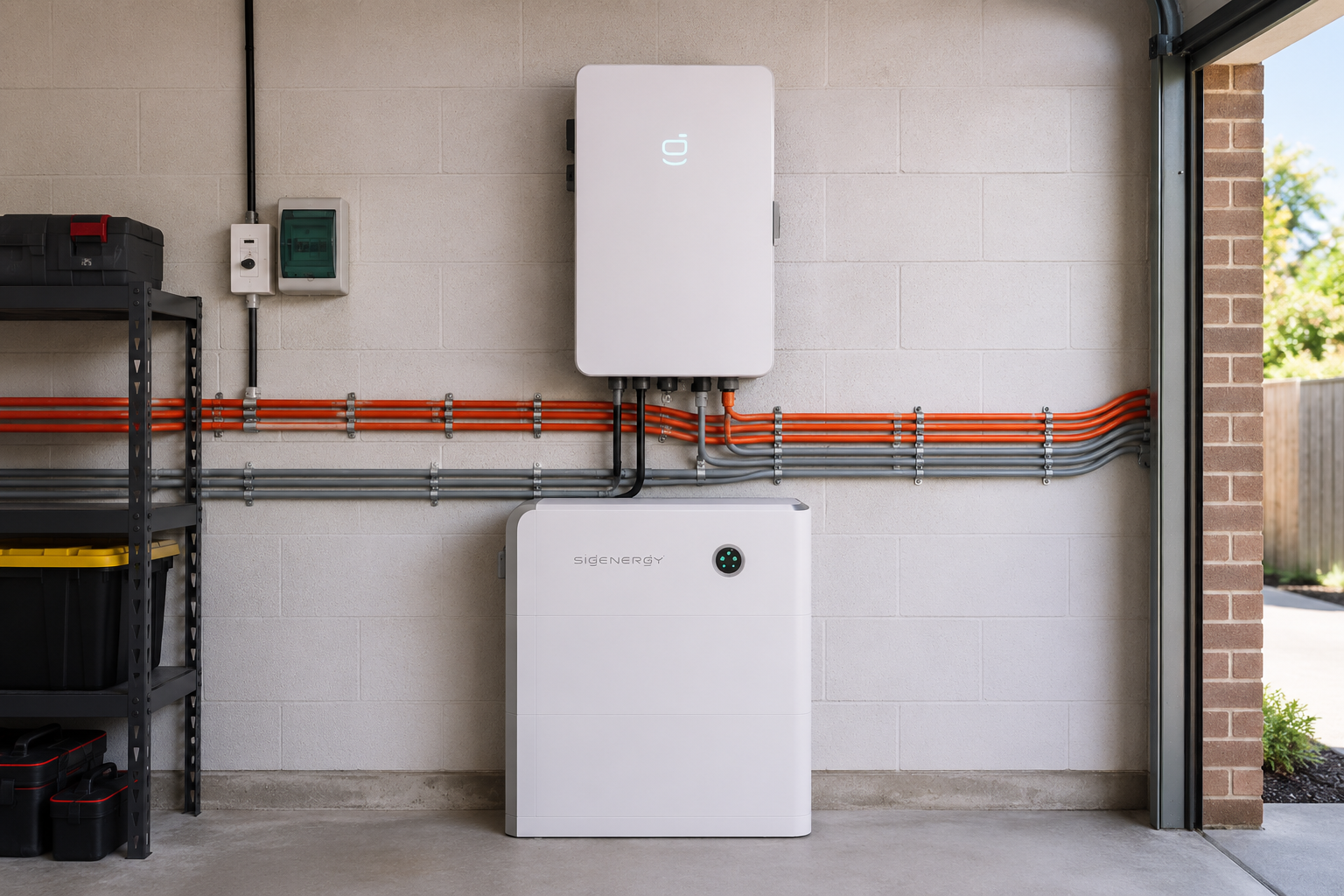
Quick answer: Most Australian homes are well matched to a solar battery size of roughly 10–14 kWh of usable capacity, but the right size for your home depends on how much electricity you use after sunset, how large your solar system is, and whether you plan to add an EV or electric appliances. The most reliable way to get your solar battery size right is to compare your real energy use against your solar generation, then confirm the result with a site assessment.
Choosing a battery is one of the most confusing parts of going solar — and getting the size wrong is costly either way. Too small, and you'll still be buying expensive grid power every evening. Too large, and you've paid for capacity you rarely use. This guide walks you through how to calculate the right capacity for your household, with general size guides for typical Australian homes.
BESS Australia is an accredited, multi-brand supplier and installer of home battery systems, with supply-and-installation across Brisbane, the Sunshine Coast, the Gold Coast, Sydney and Melbourne, and equipment supplied Australia-wide.
First, two terms worth knowing
Usable capacity is the amount of energy you can actually draw from a battery, measured in kilowatt-hours (kWh). It's usually a little less than the nominal (or rated) capacity, because most batteries hold a small reserve to protect their lifespan. When you compare batteries, always compare usable kWh — that's the figure that affects how long your home runs on stored solar.
Self-consumption simply means using the solar energy your panels generate rather than exporting it to the grid for a low feed-in rate. A battery exists to lift your self-consumption: it stores cheap daytime solar so you can use it at night instead of buying expensive grid electricity.
What size battery does an average Australian home need?
As a general guide, an average Australian family home (3–4 people) is often suited to a battery of around 10–14 kWh of usable capacity. That range tends to cover a typical evening of cooking, lighting, screens, and heating or cooling, plus part of the overnight load, using solar stored earlier in the day.
That's a starting point, not a rule. Your actual need shifts with the size of your household, how much energy you use after dark, your solar system size, your tariff, and your plans for an EV or electric hot water. The sizing tables below break this down by household type.
How do I calculate the right solar battery size?
To size a solar battery, work out how much electricity you use after the sun goes down, then choose a usable capacity that covers most of that evening-and-overnight load. Here's a simple step-by-step method:
-
Find your daily usage. Check your electricity bill for your average daily consumption in kWh, or use the Australian Government's Energy Made Easy bill-comparison tool to review your usage. Many Australian homes use somewhere between 16 and 25 kWh per day, though yours may differ.
-
Estimate your evening and overnight use. This is the portion your battery actually needs to cover — typically the energy used from late afternoon through to the next morning, when your panels aren't producing.
-
Subtract what solar still covers. In the shoulder hours (early morning and late afternoon) your panels may still be generating, so the battery doesn't have to cover the entire after-dark figure.
-
Account for usable capacity. Size against usable kWh, not nominal, so you're not caught short on cold or cloudy evenings.
-
Add headroom for future loads. If an EV, heat-pump hot water, or a bigger air-conditioning load is on the horizon, build in extra capacity now (more on this below).
-
Match it to a real product — and a site check. A battery's right size on paper still needs to suit your switchboard, your electrical phase, and your existing solar. A qualified assessment confirms the fit.
Sizing your system? Get a personalised battery sizing recommendation and quote from BESS Australia — call 1300 859 066, email sales@bessaustralia.com.au, or request a personalised quote.

Home battery size based on electricity use
The simplest way to choose a solar battery size is to match it to your household's electricity use — bigger, busier homes generally need more storage. The table below gives indicative ranges. Treat every figure as a general estimate that depends on your specific household, solar system and habits — not a guarantee of performance.
|
Household profile |
Typical daily use (estimate) |
Indicative evening/overnight use |
General battery size guide |
|
Small / efficient (1–2 people) |
~8–12 kWh |
~4–6 kWh |
~5–10 kWh usable |
|
Average family (3–4 people) |
~16–20 kWh |
~8–10 kWh |
~10–14 kWh usable |
|
Large / high-use (5+ people, pool, ducted A/C) |
~25–35 kWh+ |
~12–18 kWh |
~15–20 kWh+ usable |
|
EV-charging household |
add ~7–10 kWh per typical charge |
varies widely |
size up, or charge from daytime solar |
These ranges are a starting point for conversation, not a prescription. The accurate number for your home comes from your real consumption data and a site assessment.
10kWh vs 20kWh solar battery: which suits you?
A 10 kWh battery typically suits a smaller home with modest evening use, while a 20 kWh battery suits a larger, high-use household — especially one charging an EV or running electric heating and cooling. Here's how the two compare in practice:
|
Factor |
~10 kWh battery |
~20 kWh battery |
|
Best fit |
Smaller homes, modest evening load |
Larger homes, high evening/overnight load, EV charging |
|
Overnight cover |
Often covers a typical evening plus part of the night |
Can cover most of a full night, with some cloudy-day reserve |
|
Upfront cost (AUD) |
Lower |
Higher |
|
Backup during an outage |
Fewer circuits / shorter runtime |
More circuits / longer runtime (configuration-dependent) |
|
Best when |
Daytime-heavy usage, smaller solar array |
Large solar array, EV, pool, electric heating/cooling |
The "right" answer is rarely the biggest battery — it's the one that captures the solar you'd otherwise export and covers the load you'd otherwise import. Browse current home battery systems to see the usable-capacity options available.
Is a 10kWh solar battery enough for a family?
A 10 kWh battery is often enough for a smaller or energy-efficient family, but a larger family with high evening usage may benefit from 13–16 kWh or more. If your household runs ducted air-conditioning, a pool pump, an electric hot-water system or charges an EV overnight, a single 10 kWh battery can run flat before morning — which means topping up from the grid at peak rates.
If you're unsure, it's usually wiser to size for your winter evening load (when solar generation is lower and heating use is higher) rather than your gentlest summer day. Many modern batteries are also modular, so you can start sensibly and add capacity later.
Solar battery size for existing solar
If you already have solar panels, your battery size should be matched to both your current usage and your existing system's size and inverter. Your panels' daily output sets a practical ceiling on how much you can realistically store — there's little point sizing a 20 kWh battery to a small array that can't charge it fully on shorter days.
Compatibility matters here. A hybrid inverter — an inverter that manages both solar panels and battery storage — is needed to add a battery to many systems, and whether your current inverter is "battery-ready" affects what's involved. Your home's electrical phase (single-phase or three-phase) and switchboard also shape the options. This is exactly the kind of detail a site assessment confirms, so you're not left with a battery that can't be charged or a system that won't pass network approval. If you're also reviewing your array, our solar panels range pairs with battery-ready inverters.
Best battery size for night usage
To cover your nightly usage, size your battery to your evening-and-overnight load rather than your total daily use — the daytime portion is usually handled by solar directly. For many homes, the after-dark figure is roughly half of total daily consumption, which is why a 16–20 kWh-per-day household often lands on a 10–14 kWh battery.
Backup is a separate question. Not every battery automatically powers your whole home during a blackout — that depends on the inverter, the backup configuration and which circuits are wired to it. If running essential appliances through an outage is a priority, mention it early so the system is designed for it, because it can influence both the size and the setup.
Don't forget future loads: EVs and electrification
If an electric vehicle, heat-pump hot water or more electric appliances are on your roadmap, size your battery (and solar) with that growth in mind. A single EV charge can add 7–10 kWh or more to your nightly draw, which can quickly outgrow a battery chosen for today's usage alone.
You don't always need a bigger battery for an EV — charging the car from daytime solar is often the smarter move — but the household energy plan should account for it. If you're weighing this up, our home EV charger range and supply-and-install team can help map solar, battery and charging together rather than in isolation.
What about rebates? Sizing and the Cheaper Home Batteries Program
Battery rebates can reduce your upfront cost, but eligibility depends on the approved product, the installation and the current program rules — so confirm eligibility before you commit to a size. The Australian Government's Cheaper Home Batteries Program provides a discount toward eligible battery installations, and the discount reduces over time through to 2030. That makes it worth getting accurate advice sooner rather than later, but the right move is still to size for your home — not to over-buy chasing an incentive.
Because approved-product lists and eligibility criteria change, we'll confirm what currently applies to your situation as part of your quote rather than promising a fixed amount.
How BESS Australia helps you size it right
BESS Australia is an accredited supplier and installer of home battery, solar and EV-charging systems, offering complete supply-and-install battery packages as well as equipment-only supply Australia-wide. We carry an extensive range of tier-1 brands — including GoodWe, Fox ESS, Sigenergy, Tesla, BYD and Sungrow — under one roof, so your recommended size isn't limited to a single manufacturer's lineup.
Our trust signals are straightforward: CEC-approved products, Smart Energy Council membership, the NETCC Approved Seller consumer-protection code, installation by installers accredited under Solar Accreditation Australia, manufacturer warranties, a workmanship warranty, and Australian Consumer Law protections. We also offer a Lowest Price Guarantee, finance options and rebate assistance. Any savings, payback or bill-reduction figures we discuss are estimates that depend on your household, tariff and usage — never guarantees.
Get the right size the first time. Request a personalised battery sizing recommendation and quote from BESS Australia — call 1300 859 066, email sales@bessaustralia.com.au, or use our request a personalised quote form. We'll review your usage, your existing solar and your future plans, then recommend a capacity that actually fits your home.
FAQ
How do I calculate the right solar battery size? Start with your average daily electricity use from your bill, then estimate how much you use after sunset — that evening-and-overnight figure is what your battery needs to cover. Subtract what solar still supplies in the shoulder hours, size against usable kWh, and add headroom for future loads like an EV. A site assessment confirms the fit.
What size battery does an average Australian home need? As a general guide, an average family home of 3–4 people is often suited to around 10–14 kWh of usable capacity, enough to cover a typical evening and part of the overnight load from stored solar. Smaller homes may need less, while high-use households with pools, ducted air-conditioning or EVs often need more. Your actual figure depends on your usage.
Is a 10kWh solar battery enough for a family? A 10 kWh battery is often enough for a smaller or efficient family, but larger families with high evening usage may need 13–16 kWh or more. If you run ducted air-conditioning, a pool pump or charge an EV overnight, a 10 kWh battery can run flat before morning. Sizing to your winter evening load is a safer approach.
Can I size a battery to my existing solar system? Yes — and you should. Your existing panels' output sets a practical limit on how much you can store, and your inverter and electrical phase affect compatibility. A battery usually needs a hybrid inverter to manage charging and discharging, so whether your current inverter is battery-ready influences the options. A site assessment confirms what suits your system.